Showing posts with label History. Show all posts

Monday, 7 July 2014

(Attempting to) Make that which is uninteresting, interesting

Sydney residents are genuinely spoiled. There is an almost an overwhelming amount of things to see and do locally - stunning national parks, world class beaches, art, festivals, great food, coffee and wine. All against the backdrop of a beautiful, cosmopolitan, laid-back city. With such a streak of good stuff, we were bound to strike out eventually. And strike out we did.

Cockatoo Island today
Cockatoo Island, isn't exactly the Opera House,  but it is a pretty famous and well-regarded Sydney landmark. The history of the place is interesting enough - it's a tiny island in Sydney Harbour that was used to house convicts starting in the mid-19th century and later served as a reform centre for shall we say, ladies of the night and such. Think of it as a sort of Australian Alcatraz-cum-industrial centre.

Convict labor helped to turn the island into a shipbuilding site that reached its heyday during WWII (long after the convicts were gone). The few photos on the self-guided tour show an impressive operation, the largest ships appear to have dwarfed the island in size. Work on the final ship built at Cockatoo Island commenced in 1979 and by the early 90s the island was relegated to the largely deserted industrial wasteland that it is today.

The problem with Cockatoo Island is not that there isn't an interesting history behind it, but that there is nothing to see. I assure you that by reading the account you will have virtually the same experience as if you went there in person (minus the disappointment). Since Cockatoo Island was operational until relatively recently, that means it was a functioning industrial site long enough for all the interesting stuff of historical note to have been long since replaced, destroyed or removed.

Cockatoo Island is for all intents and purposes a scrap of prime real-estate in Sydney Harbour, covered in locked, empty, mouldering warehouses that are masquerading as a tourist attraction. The only benefit to being on Cockatoo Island, is that since you are standing on it, it is no longer a concrete blot on an otherwise pleasing view.

After our visit, I couldn't resist the urge to look up Cockatoo Island on TripAdvisor, just to see what others thought. (Insert caveat here, that I normally find TripAdvisor quite unreliable, more on that in an upcoming post.)

Anyway, Cockatoo has pretty solid reviews on TripAdvisor.
  • 170 Excellent or Very Good 
  • 24 Average
  • 13 Poor or Terrible
Now my disappointment in Cockatoo Island has nothing to do with a general disinterest in history or unwillingness to read a few plaques etc. I have not one, but two history degrees, and I thought it was boring.

Port Arthur, Tasmania
So we trawled through a lot of the reviews and noticed an interesting pattern. Most of the people who really enjoyed it were actual Australians.

Now for some insight into the Australian psyche. Australians are very self-conscious of their relative 'newness' as a nation. They crave to have a kind of European History; this is why you'll meet the odd Australian who still talks about the UK as 'home' even though they've never been there. And let's face it, Australia is so young in 'Western' historical terms that it makes the United States look old.

 I don't say this to be critical, I think it's nice that Australia wants to carve out it's own modern historical narrative (and it's kind of quaint). And, Australian convict history is and can be visually and physically interesting and very moving. Cockatoo Island forms part of a 10-location World Heritage Site of convict locales throughout the country. Make the trip to Tasmania (an actual underrated destination) and go to Port Arthur (another site on the World Heritage listing) instead - now that really is a fascinating place (and Tassie has really good wine too).

But, this perceived lack of history is also rather problematic. The modern Australian narrative (although it is has improved significantly over the last 20 years or so) is still very much a santized, white-washed (no pun intended!) version of history. (*Before you shout 'hypocrite', yes, I am very aware you could say the same about much of American history!)

Red Hands painting at Ku Ring Gai
Anyway, take this for example; on Saturday we headed out to Ku Ring Gai National Park which aside from wildlife (we saw a wallaby) and amazing hiking trails, has numerous underrated and largely unvisited Aboriginal cave paintings and carvings that have - get this, an upper age limit of 2000 years!

Two. Thousand. Years. There is your history, Australia. Cave paintings, still in existence after all those years of exposure and made of nothing more than pigments from local plants. How about a little more historical pride there?

Friday, 27 June 2014

History lesson

In 2014, the (relative) isolation of Western Australia's nearly 8000 miles (nearly 13,000km) of coastline is a wonderful and welcome thing. Even today there are hardly more than a few handfuls of coastal communities along this vast stretch, and most of them clustered in southwest corner of the state. But I wonder what it would have been like to be the first and only two Europeans left on this desolate stretch of land in the year 1629.

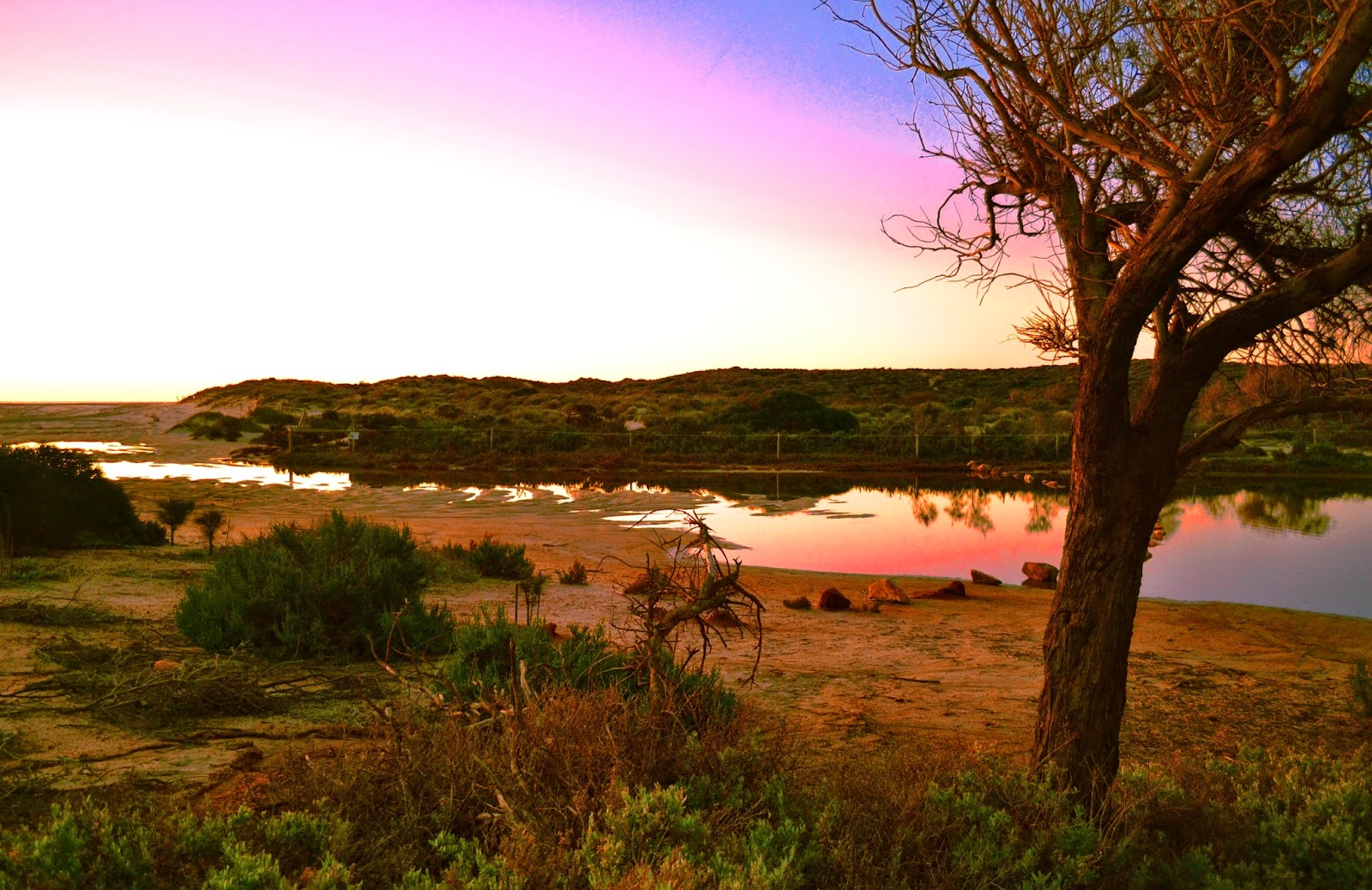
The stretch of beach where the two young Dutch sailors are thought to have been deserted
Western Australia gives a whole new meaning to the term 'big sky' (sorry Montana). Vast open skies that are so alluring during the daylight hours and positively mesmerising at sunset become oppressive and all-encompassing after nightfall. This is a rare corner of the world where night is still truly pitch black. I would think that the first night  for these first settlers must have been awfully scary, the relentless roar of the surf, the complete darkness and maybe even a visit from some curious local wildlife.

But I get ahead of myself, the story of how two young Dutchmen ended up stranded on a lonely stretch of beach near present day Kalbarri is exactly the kind of bonkers tale that Australia seems to produce at remarkably frequent intervals.

The Western Australia coast is dotted with reefs, rocks and outlying islands which to this day are a hazard for maritime vessels. The coast is literally littered with shipwrecks. In 1629 a Dutch ship, the Batavia, ran aground on some offshore islands and although over half of the passengers were drowned or swept out to sea, there were roughly 200 survivors which included an unsuspecting captain and several crew who had already been planning a mutiny for some weeks.

Captain Francisco Pelsaert along with a handful of loyal crew members hopped in a longboat and set off for Jakarta. Unbelievably, they made it to Jakarta and back again in about five months. That in itself is extraordinary, but what happened in their absence is even more bizarre - and grim. The would-be mutineers led by a religious zealot and all-round nutcase, Jeronimus Cornelisz swiftly began picking off survivors who were not a part of their merry-band, seeing them as a drain on very limited resources. In total they viciously murdered about 125 of the 200 survivors.

Wittecarra Creek
In another seemingly impossible twist of fate, some of the survivors managed to escape to a nearby sandbar and very narrowly managed to hail the captain first upon his return and explain the situation. Cornelisz and his top henchmen were hanged on the spot and others were shackled and transported back to Jakarta for trial and ultimately, hanging.

 For reasons unknown, Pelsaert took pity on two of the younger offenders and delivered them to the mainland, on a stunning but desolate stretch of beach just outside of present day Kalbarri.

Today a small out-of-the-way stone monument commemorates the occasion. It is just a hundred meters or so down a dirt track marked only as Wittecarra Creek. There is a single parking space and the track gives way to sand before it peters out on the beach. You'd be lucky to stumble upon it if you didn't know to look for it.

As most people know, Australia later became a British penal colony (the Dutch lost interest in Australia after a few too many expensive and deadly encounters with the aforementioned coastal hazards) but the irony that the first two permanent white settlers in Australia were of criminal stock did not escape me.

No one knows what happened to our two young sailors. Whether they lived out their days fishing and enjoying the glorious sunsets of Western Australia, died of starvation or thirst or fell in with some friendly or unfriendly Aborigines is unknown.

Australia is full of this kind of stuff. In the words of Roman Mars, Always Read the Plaque.


Wednesday, 20 February 2013

Burma roundup

It's taken a long time for me to gather my thoughts on Burma. I spent a big chunk of the trip on the bathroom floor reading Orwell's Burmese Days, listening squealing children and squawking chickens filter through the open window.

Burma is is much like India - or rather, I imagine, much like India was before it had millionaires or even a modern middle class. Like India, Burma has a the same recognisable British colonial legacy and is full to bursting with blinding colours and grinding poverty in a landscape composed of steep mountains, flat dusty plains and tropical bush.

It's much like India, but also much like Laos and northern Thailand; the Burmese have the same gentleness that characterizes the Laotians and Thais and the same remarkably unperturbed indifference to foreigners.

So maybe what Kipling wrote in 1898 remains true, 'This is Burma, and it is unlike any land you know about.'

Burma is more than just the collective attributes of its neighbours; but it's hard not to draw comparisons. The people are beautiful and subtle shifts in ethnicity are revealed as you travel up and down the country - some look almost Indian, others thoroughly Chinese - and everything in between. 

A universal feature amongst the Burmese seems to be the application of Thanaka, a cream coloured paste worn decoratively as make-up, but also as protection against the sun and is said to have cooling properties. It seems to most often be worn in a thick smear beneath the eyes, not unlike a tobacco-chewing American baseball player.

Burma is perhaps less reliant on modern technology than anywhere I have ever been.  Power cuts were constant, but unsurprising.  What did surprise me was the almost complete absence of cell phones.  I think of cell phones as a fairly democratic piece of technology these days, you can pick up a cheap Nokia for $10 just about anywhere. I suspect in Burma, the issue is not the cost of the phone but that phone networks barely exist and there is, almost literally, no one to call.

I suspect landlines in the home are also fairly uncommon.  The typical Burmese phone booth looks something like this:

An attendant sits in a dingy stall on the side of a road with a range of phones (that have probably not been manufactured in the developed world for about 15 years) - and people come along and pay to use them. 

Users battle the noise of passing pedestrians and traffic and of course every word you say is over heard - not an ideal setting for an intimate conversation or conducting business.

With the exception of Coca-Cola and a few car and electronics companies - and Singapore is making a big play with Tiger beer - there are virtually no international brands.  Everything in Burma, is made in Burma - making most goods cheap - in both meanings of the word.  Mastercard is the first (and this is within the last year or so) and only credit card that has any presence, in the entire country. International banks are non-existent.

Burma is like stepping back in time in a way that is utterly refreshing, yet also makes you wince. Even our fairly modest trip, on a modest budget made me feel a bit like a modern-day Marie Antoinette.

Monday, 29 November 2010

Melaka

On Saturday we packed our bags and headed south to here:

Melaka is certainly one of the more famous and more popular tourist destinations in Malaysia.  Our Rough Guide gets a bit down on it for being touristy (and then devotes 20+ pages to it), but despite all the tourists we found it quite pleasant and a nice break from KL.  Melaka (also sometimes spelled Malacca) is one of the oldest cities in Malaysia (14th century) and at one time was certainly one of the most important both in cultural and economic terms.  It was originally founded by a Sumatran prince in exile who got on well with the locals and Melaka quickly became an affluent trading outpost between India and Indonesia.

Thanks to its strategic location and wealth Melaka proved irrestible to the Europeans and as a result Melaka has a particularly long and varied colonial history.  The Portugese cruised in about 1500 and then 100 years later the Dutch relieved the Portugese of their duites.  The Dutch hung on for nearly 200 years but they were no match for the Brits who, save the Japanese occupation during the Second World War, hung onto it until Malay independence in 1957.  On top of this the Chinese have been flocking to Melaka for a couple hundred years as well.  The result, is a bizarrely coherent yet wonderfully diverse little town that deservedly (I think) achieved UNESCO World Heritage status 2 years ago.

Aside from the wonderful architecture, Christian churches, Buddhist temples, mosques and Hindu shrines sit quite happily next to each other, the food and the markets are the real highlight.  The standout food of Melaka, commonly referred to as Nyonya cooking is based on Chinese ingredients and cooking techniques with local Malay and Indonesian (and occassionally Indian) herbs and spices.  The result is amazing.


As for the markets you can buy all the usual tat that you can get at any market anywhere in the world but there are some standout shops particularly in terms of furniture and antiques.  It is a reprint, and after some mediocre haggling Ian picked up an amazing map of British Malaya ca. 1834 for about $15.00.  Borneo appears almost entirely blank with the following note:

'Borneo produces gold, tin, diamonds, camphor, spices &c.  Interior unknown but inhabited by the aboriginal Dayaks, & the coasts by Malays & Chinese.  Borneo is three times larger than Great Britain & divided into several independent states. Probable population 3,000,000.'