Showing posts with label Kalbarri. Show all posts

Friday, 27 June 2014

History lesson

In 2014, the (relative) isolation of Western Australia's nearly 8000 miles (nearly 13,000km) of coastline is a wonderful and welcome thing. Even today there are hardly more than a few handfuls of coastal communities along this vast stretch, and most of them clustered in southwest corner of the state. But I wonder what it would have been like to be the first and only two Europeans left on this desolate stretch of land in the year 1629.

The stretch of beach where the two young Dutch sailors are thought to have been deserted
Western Australia gives a whole new meaning to the term 'big sky' (sorry Montana). Vast open skies that are so alluring during the daylight hours and positively mesmerising at sunset become oppressive and all-encompassing after nightfall. This is a rare corner of the world where night is still truly pitch black. I would think that the first night  for these first settlers must have been awfully scary, the relentless roar of the surf, the complete darkness and maybe even a visit from some curious local wildlife.

But I get ahead of myself, the story of how two young Dutchmen ended up stranded on a lonely stretch of beach near present day Kalbarri is exactly the kind of bonkers tale that Australia seems to produce at remarkably frequent intervals.

The Western Australia coast is dotted with reefs, rocks and outlying islands which to this day are a hazard for maritime vessels. The coast is literally littered with shipwrecks. In 1629 a Dutch ship, the Batavia, ran aground on some offshore islands and although over half of the passengers were drowned or swept out to sea, there were roughly 200 survivors which included an unsuspecting captain and several crew who had already been planning a mutiny for some weeks.

Captain Francisco Pelsaert along with a handful of loyal crew members hopped in a longboat and set off for Jakarta. Unbelievably, they made it to Jakarta and back again in about five months. That in itself is extraordinary, but what happened in their absence is even more bizarre - and grim. The would-be mutineers led by a religious zealot and all-round nutcase, Jeronimus Cornelisz swiftly began picking off survivors who were not a part of their merry-band, seeing them as a drain on very limited resources. In total they viciously murdered about 125 of the 200 survivors.
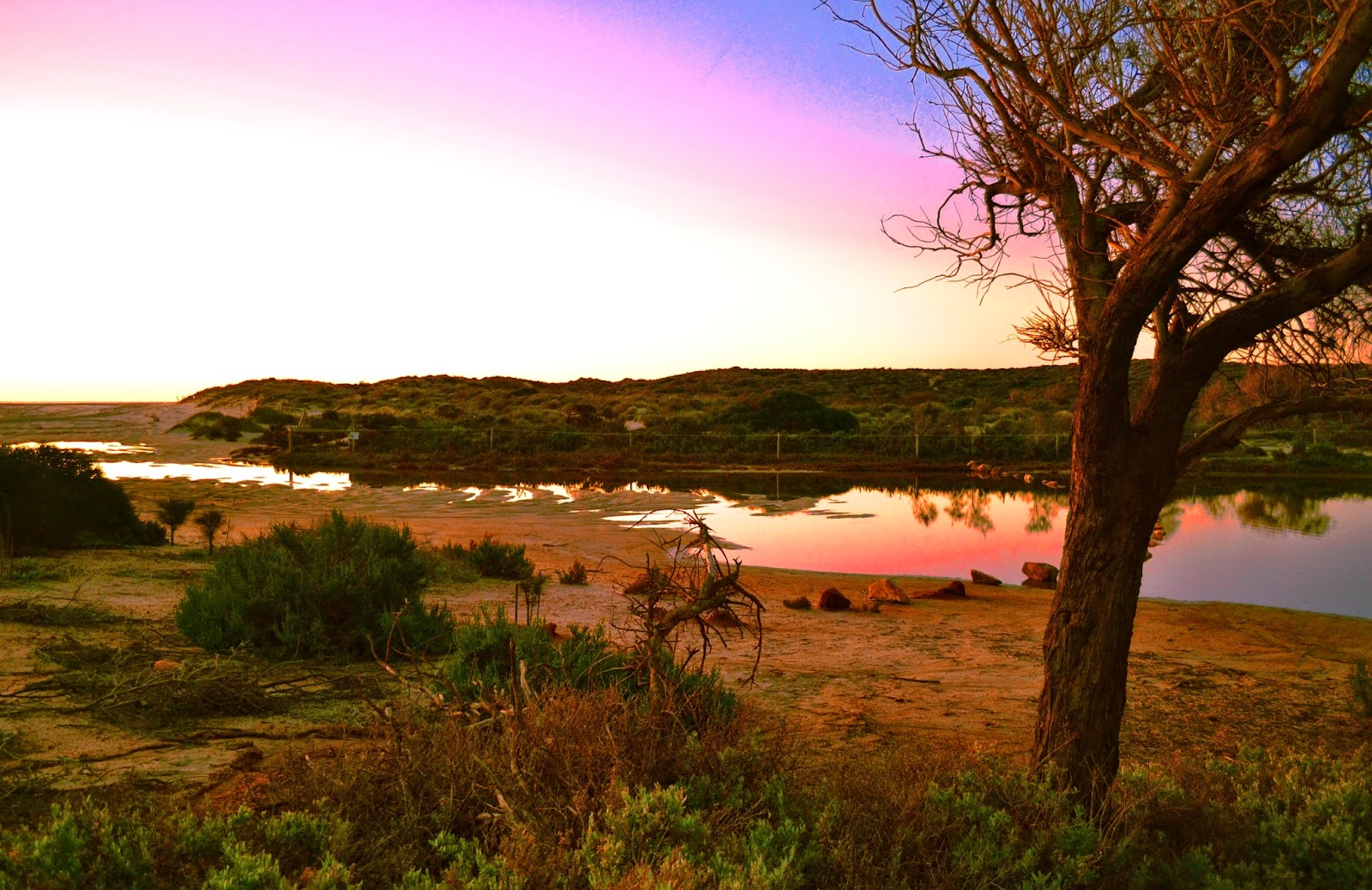
Wittecarra Creek
In another seemingly impossible twist of fate, some of the survivors managed to escape to a nearby sandbar and very narrowly managed to hail the captain first upon his return and explain the situation. Cornelisz and his top henchmen were hanged on the spot and others were shackled and transported back to Jakarta for trial and ultimately, hanging.

 For reasons unknown, Pelsaert took pity on two of the younger offenders and delivered them to the mainland, on a stunning but desolate stretch of beach just outside of present day Kalbarri.

Today a small out-of-the-way stone monument commemorates the occasion. It is just a hundred meters or so down a dirt track marked only as Wittecarra Creek. There is a single parking space and the track gives way to sand before it peters out on the beach. You'd be lucky to stumble upon it if you didn't know to look for it.

As most people know, Australia later became a British penal colony (the Dutch lost interest in Australia after a few too many expensive and deadly encounters with the aforementioned coastal hazards) but the irony that the first two permanent white settlers in Australia were of criminal stock did not escape me.

No one knows what happened to our two young sailors. Whether they lived out their days fishing and enjoying the glorious sunsets of Western Australia, died of starvation or thirst or fell in with some friendly or unfriendly Aborigines is unknown.

Australia is full of this kind of stuff. In the words of Roman Mars, Always Read the Plaque.


Tuesday, 24 June 2014

Kalbarri Redux

We've just spent a few fabulous days in Kalbarri, Western Australia. This trip wasn't breaking new ground for us, we were here about five years ago. But the opportunity to return to far flung places is a real luxury and last time we were here, we didn't have nearly enough time to do it justice.

In Western Australia terms, this place isn't particularly far flung. We are a mere 6.5 hours north of Perth. Western Australia covers an area roughly the same size as the continental United States from the Rocky Mountains to the West Coast, that's a big space.

Even more astounding is that the entire population of Western Australia is only 2.5 million people - and 1.7 million of those people live in Perth, leaving a mere 800,000 people dotted around the rest of state. For a bit of context, that's like if the population of Utah was spread over the entire western 1/3 of the United States. Western Australia makes the American West look and feel crowded.


Back to Kalbarri. Kalbarri is a hokey little town with 2 pubs and about 3 fish and chip shops. You can get a decent cup of coffee and there is a moderately well-stocked supermarket. Everything you need for a few days exploring and not much more.

Like so many other places in Western Australia, I'm sure that if Kalbarri was located anywhere else it would be world famous. Sure, the population of town swells in the summer months and there is a steady trickle of grey nomads the rest of the year, but it's hardly the worldly destination that it would be if it weren't so remote. This suits me just fine.

Kalbarri is planted at the mouth of the Murchison River where it empties into the Indian Ocean. The Murchison River has carved out  a stunning series of gorges that makes up the bulk of the National Park.

This trip we managed to complete the 9km Loop Trail that plunges down into the gorge and follows the sandy banks of the river before it turns into a (at times poorly) marked trail that leaves you scrambling along precarious weathered red rocks hanging over the river. Eventually you make the steep climb out of the gorge and follow the relatively narrow ridge of the gorge wall (about a 150 meter drop down to the river) back to where you started. It's a brilliant class 4 (out of 6) hike and suggests 3.5-5 hours to complete it. We did it in 3 hours with a lunch break. It would be a punishing trip in the summer when temperatures can soar to 50C/120F. We did it in a mild 16C/60F.

The other big attraction at Kalbarri is the stunning, and I do mean stunning, coast line. A dramatic stretch of bright red cliffs follow the coast south of the town and to the north 200km of sandy dunes stretch all the way to the World Heritage area of Shark Bay. There are numerous paths and lookout points along the coast, or you can do as we did and ditch the trails and (cautiously) climb along the cliffs.


The surf along this stretch of coast is relentless and provides a steady stream of brilliant turquoise waves. Year-round it is pretty easy to spot dolphins, whales and seals (we've seen all of the above this trip) but if you miss out on the local wildlife, the local surfers make a pretty good consolation prize as they gather in the late afternoon to show off their skills as the brilliant sun slips into the sea.