Friday, 22 June 2012

Indian wedding survival guide

Exactly one year ago today I woke up in Chennai, India at 3:00am with just a few hours alcohol-induced sleep and stumbled out into the stifling heat of the Indian summer - so began the finale of the traditional week-long, south-Indian wedding that had reduced me to a shell of a woman.
  
The bride had warned us - and anticipating our helplessness in the face of daunting tasks such as sari fittings and communicating with Tamil-speaking drivers, the bride enlisted an army of friends and relatives to escort (er . . . babysit) us about Chennai.  (If not for their help and guidance I'd probably still be trying to figure out how to tie a sari.)


Things kicked off the night we arrived with a 'small get-together for close friends and family' (probably around 100 people) at the home of the parents of the bride.  There was a huge marquee bedecked with jasmine flowers, a well stocked open bar and buffet and a local DJ was on hand to play some Tamil classics.  It was easily the equivalent of your average Western wedding reception - and this was just the pre-warm-up, warm-up.

This was followed by a hungover shopping frenzy - all the girls getting fitted for saris, salwar kameez and stocking up on matching bangles whilst the boys fussed over kurtas and sandals.

Our next event was Sangeet. Sangeet has northern Indian origins (from the Punjab) but is widely practised throughout the country (and certainly within the Indian diaspora).  


Loosely defined Sangeet is a grand affair during which the friends and family of the bride and groom perform a range of traditional (and not-so-traditional) songs and dances - rehearsed for weeks - even months in advance.  

Sangeet was like a night at the Oscars (or perhaps the Bollywood equivalent) - the bride and groom literally looked like movie stars.  It was almost inconceivable to me that this was the same girl with whom I had shared a dank, crappy dorm with as a graduate student.

Next up was Mehndi - another open bar affair at another posh hotel.  The bride spent the majority of the day perched on a throne whilst four women attended to her covering her hands and feet in henna.  Female guests also queued up to have a mini-version done on their own hands.

After Mehndi came the engagement and finally the wedding itself.  The engagement and wedding take place at a marriage hall.  The engagement began with a procession of singers and dancers followed by the bride and groom in a horse drawn carriage.  (This is followed by a lot of stuff, which quite frankly I didn't understand!) The following day at the appropriate auspicious time as determined by the Tamil calendar the wedding ceremony begins. In this case a very early 5:00am.  

There were priests chanting in Sanskrit (I think) whilst the groom was primed for the ceremony.  Following this was a fantastic display of the groom 'running away' as the bride 'chased' after himPersuaded to return, the bride and groom are hoisted on the shoulders of friends while the bride attempts to çapture' her husband by throwing a wreath of jasmine around his neck.  (This was again followed by several costume changes and lots of things I didn't understand).  


There were well over 1000 people in attendance.  About a week after the wedding I was chatting to the mother of the bride and she said, 'oh I keep bumping into people we forgot to invite, I'm so embarassed!'

It was a truly unforgettable experience and I really (still) can't thank Lavanya and Ayyappan enough for their attention and hospitality.  (You can have no idea how glad I am that they came to our wedding first - theirs would have been an impossible act to follow.) 

I would of course also like to add a great big happy first wedding anniversary to Ayyappan Hariharan and Lavanya Iyer.  Their first baby is also due today (but is so far showing no signs of making an appearance!)  

PS Indian weddings are not for the faint of heart.  Pack plenty of asprin.

-----------------------------------------------------------------------------------------
You can also view my photos of Sangeet, Mehndi and the wedding.

Wednesday, 20 June 2012

Tropical transport traumas


If there are two things in this world that wind up my husband, it's paying too much for transportation/parking and a meal without enough carbs (we'll come back to the carbs some other time - today is all about transport).

This normally patient, reasonable man pushes the boundaries of sanity when confronted with an issue of 'over-priced' transportation.  He brooded unhappily for hours (and still frequently re-lives) a traumatic parking experience in downtown Chicago. He actually did the math on how much a parking space at Bloomingdale's makes in a year (depressingly, it makes a lot - more than me if occupied nearly 24 hours a day 365 days a year).

There was the $7.00 taxi ride in Laos that threatened to destroy (and according to Ian, bankrupt) our entire holiday and there are the unwitting taxi drivers in KL that occasionally take him for a tourist and try to get him off the meter (insert here a long string of expletives in an English accent).  There's also the far-reaching conspiracy to make access to London's Heathrow airport cost the equivalent of a large diamond ring.

Over the years, we have probably saved upwards of $10 and lost nearly 20 hours of our lives over by taking a firm stand against corrupt transportation.

Then we went to Indonesia.

Now as I mentioned before Yogjakarta is a touristy town with touristy hassles.  Yogja has a complete over-abundance of becak drivers.  Becaks are the Indonesian of equivalent of the rickshaws and tuk-tuks that ply the streets throughout the rest of Asia.

 Becaks in Indonesia are typically un-motorized - they are almost always comprised of small carts attached to the front of a rusty old bike, pedaled by a poor, sinewy, sun-tanned man ranging anywhere from the age of 20-60.  Occasionally you may get one that is pulled by a horse.

 It's a thankless, hot job and with there being so many becaks, you'd think that competition would be fierce - and it is, when it comes to stalking and harassing tourists.  It's hot, you're tired, you relent.

Okay, okay to the kraton, how much then? 
20,000 rupiah.
You're joking.
No, 20,000.
No.
How about 10,000?
No.
Seriously?
No.

At this point I probably have to forcibly restrain Ian and drag him off down the street.  He mutters obscenities under his breath, I comment on how the exercise is good for us anyway.

No doubt you're now wondering, well how much is 20,000 rupiah?  It's a lousy $2.00.

But, let's put this into perspective.  A school teacher in Indonesia makes that much in a whole day of teaching - and this guy who has been having a siesta under a frangipani tree all morning wants that for 20 minutes work.

It's a tough call.  In local terms that ride should cost between $0.30-0.50 - so $2.00 is a hefty mark-up.  I'm usually pretty happy to pay a bit of a tourist premium, but more than quadruple is irritating my sense of fair play.  Also, I suppose with such an over-supply of becak drivers that these guys probably go without a single fare for a day or two at a time.

The thing that I find most surprising (and what Ian finds more irritating) is that they won't come down $1 - they'd still getting double to triple the amount they'd get on a local fare and aren't having any of it.

A few of these encounters put Ian off Yogjakarta entirely and nearly Indonesia as whole.

There was one insolent driver who dared take my husband for a fool and wanted $5! This was the straw that broke the camels back - Ian launched into a five minute diatribe on how it wouldn't even cost that much to go twice the distance in KL where everything is doubly expensive and in a real car, not a rickety old bike.

The man probably spoke less than 25 words of English, so I let it slide.  I'm also pretty sure he got the message.

Every time someone asks Ian about our trip it begins, 'Oh it was amazing, but . . . '

-----------------------------------------------------------------------------------------------
For those you accessing this blog through the Register-Mail you can read more about my past exploits and adventures at www.wherecanigetadrink.blogspot.com.  You can also view my photos of Yogjakarta.

I welcome comments, questions, ideas and suggestions about this and future blog posts.

Saturday, 16 June 2012

Indonesia: Yogjakarta

Continuing on with our Indonesian adventures, it's now time for a stop in the city of Yogjakarta - pronounced Jog-ja-karta and often shortened to just 'Jogja'. Despite its relatively small size at just under 400,000 people, Yogjakarta is without question the cultural epicentre of Java - and Indonesia as a whole, overwhelming even the capital city of Jakarta which is home to over 10 million people.

The best possible way to sum up Yogjakarta is that it's cool. It's young, it's trendy, there's fantastic public art, museums, street dancers, musicians and a thriving industry of both authentic and knock-off local arts and crafts (artistic attractions that are often in short supply in Muslim societies).

It's as set-up for tourists as anywhere in Indonesia (outside of Bali) which naturally brings with it all the hassle and annoyance of any touristy place.

You could spend weeks just getting dragged around batik shops (batik is an Indonesian/Malaysian art of painting cloth with odd pipe-like tools).  Most batik is dreadfully tacky and overpriced. Fall victim to a smooth-talking member of the batik mafia and you could find yourself back home with a skinny wallet and piece of cloth so ugly it's not even fit for displaying in the basement.

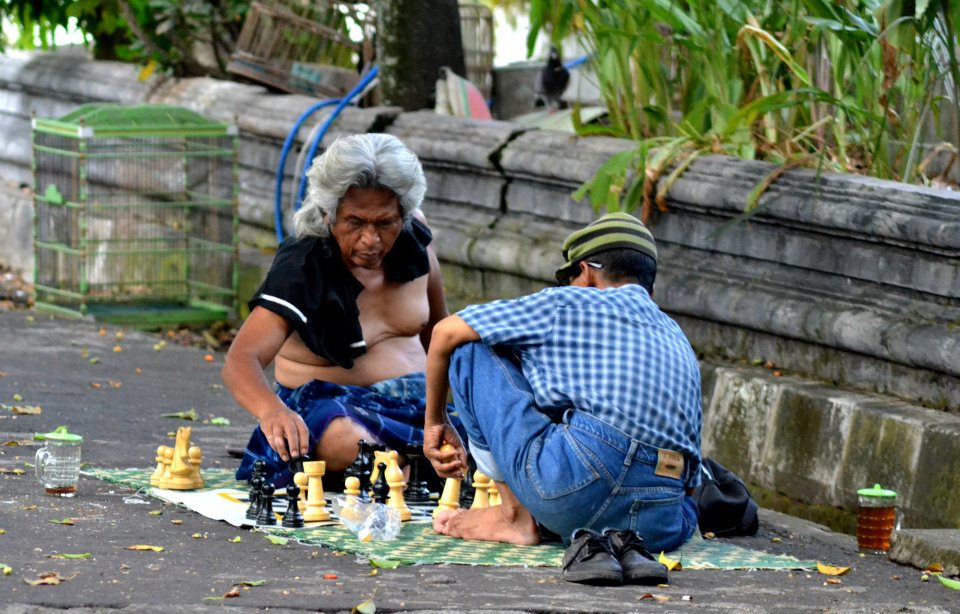
But learn to tune out the noise and Yogja is a rather special place.  It's clean (but not sterile), a wander down the less hectic residential lanes is as pleasant as a stroll around the neighbourhoods of Paris (if you can stand the heat).  Old men playing chess, kids flying kites, becak (tuk-tuk) drivers enjoying a mid-afternoon siesta and countless flowers in bloom set the scene.

The centre of the city is surrounded by run-down white walls within which lies the 'kraton' - the sultan's palace. The sultan still resides here and it has all the third-world, banana republic charm you would expect.  Thanks to a long colonial legacy, the palace is thoroughly European - and much like the colonial administrators must have done, you can visibly see the palace wilting in the tropical sun.   Baroque architecture and furniture were not made for the tropics.

The kraton is generally unimpressive, but the east meets west contradictions are thoroughly amusing.  The accompanying museum is mind-blowing.  Room, after room, after room of dusty cob-webbed furniture (European of course) chipped porcelain dolls, stained wine glasses and  . . . dirty oven mitts, sieves and cheese graters - some possibly dating back as far as 1975.

In all seriousness, this may have been the highlight of the trip.  Those cheese graters and sieves would be uninteresting if they had belonged to Elvis or the Queen of England - but the Sultan of Yogjakarta?  This is a public official so minor that I can't even remember his name.


I've been to a lot of crusty old museums all around the world (Russian museums in particular come to mind) but this was pretty special.  We giggled over it the rest of the afternoon.

More on Yogja in the next instalment - negotiating transportation and dodging food-poisoning.

Wednesday, 13 June 2012

Moving to Malaysia

I'm pleased to announce that this blog will now also be featured on the online edition of my hometown newspaper the Register-Mail. So in hopeful anticipation of an increased readership, now seems as good a time as any for a quick recap on how and why I ended up in Malaysia.

After suffering five long years of cold and rain in Scotland and England my husband (then fiance), was offered a job as an Assistant Professor of Psychology at the University of Nottingham (yes, that Nottingham - Robin Hood, Sherwood Forest etc.) Only the job offer (mercifully) was not in Nottingham, England but at the university's Malaysia Campus.

Yes, Malaysia.  That long, skinny country dangling off the edge of Asian continent right below Thailand.

Up for an adventure and a rather dramatic change of scenery we snapped up the opportunity and in six short weeks found ourselves on the 13 hour flight from London to Kuala Lumpur.  Woefully unprepared for life just 200 miles north of the equator (one doesn't require a lot of hot weather clothing in the UK) we stumbled into the stifling tropical heat and humidity and so our adventure began.

Despite the fact that virtually everyone speaks at least some level of passable English here (particularly in the city), finding a place to live, organising an internet connection, buying a car and most importantly of all  - making sure the air-conditioning works were all 'interesting' experiences.   Experiences that brought out the best and worst in both of us - countless lessons in patience and communication whilst simultaneously reinforcing our sub-conscious prejudices and pre-conceptions.

Mark Twain once said:
'Travel is fatal to prejudice, bigotry, and narrow-mindedness, and many of our people need it sorely on these accounts. Broad, wholesome, charitable views of men and things cannot be acquired by vegetating in one little corner of the earth all one’s lifetime.'
As always, Mr Twain was undoubtedly correct, but sometimes I wonder if living in a place just can't tip the balance back in favor of narrow-mindedness.

It's now been nearly two years since we came to Malaysia and with the exception of a few near total meltdowns (almost always involving some totally egregious native driving stunt)  and our fair share of food poisoning we've had a pretty good time.

In the last 20 months we've seen wild orang-utans in Borneo, been to a week-long Indian wedding, stood on the edge of a volcano in Java, scaled ancient temples in Cambodia and much more.

With so much happening in this part of the world and so much to do and see, we are nowhere near ready to say goodbye just yet (although, we certainly do miss good cheese and affordable wine!)

So to see what we've been up to, take a look through the archive of our travels and stay tuned for more - I'm currently in the midst of wrapping up on our recent Indonesia adventure and Singapore is up next.

I always welcome comments, questions, thoughts and suggestions.

Wednesday, 23 May 2012

Java: Borobudur

Overwhelmingly the single most popular tourist attraction in Indonesia, Borobudur has nowhere near the world-renown of other famous temple complexes like Angkor Wat but I can't quite figure out why . . . I mean, look at it!


Borobudur - history

I think it's almost fair to put Borobudur on a scale with Angkor Wat.  What Borobudur lacks in size and scale (not that it's by any means small) Borobudur makes up for in symmetry and surroundings.  The symmetry is eye-catching in a way reminiscent of the Taj Mahal. And whilst Angkor Wat is surrounded by pleasant flat, dense jungle, Borobudur offers commanding views across the Javanese countryside with unrivaled views of Mount Merapi (one of Java's deadliest and most active volcanoes with major eruptions in 2006 and 2010) looming in the distance.


Borobudur dates from Indonesia's Buddhist period in the early 9th century - making it nearly 400 years senior to its Cambodian rival - never mind that Borobudur has a tale of survival that tops Angkor Wat.  Angkor has famously been victim to war and neglect but Borobudur has been cursed by geography.  Surviving 13-odd centuries of earthquakes and volcanoes is no small feat - and is even more remarkable when you see how incredibly well preserved Borobudur is (it's in significantly better condition than Angkor Wat).

Like Angkor Wat, Borobudur also experienced an extended period of abandonment. Borobudur was abandoned from as early as the 11th century when the Medang Kingdom moved east after a series of volcanic eruptions and endured further neglect when Indonesia transitioned to Islam in the 15th century. Borobudur was only properly rediscovered with the arrival of the British in the late 1800s. Since then Borobudur has been restored and well-maintained, but has still been victim to attempted terrorist attacks, most recently in the 1990s.  It goes without saying that Borobudur suffers from the same problems of major monuments the world over - vandalism, pollution, littering and over-crowding.

Borobudur - visiting

Repeatedly touted as Indonesia's busiest tourist attraction, we anticipated Angkor-sized crowds.  We certainly didn't have the place to ourselves, but by comparison to Angkor Wat - Borobudur was downright deserted.  The overwhelming majority of visitors were Indonesian - largely comprised of junior high school groups.  There were probably less than a dozen Westerners there - making us a bit famous.

We had our pictures taken - both surreptitiously on phone cameras and in countless group shots with school girls and one wailing 4 year old whose father desperately wanted a photo of us with his son (the son was clearly less impressed with us).

To Ian's eternal glory he was extremely popular with 14-16 year old girl demographic.  One girl even sidled up to him, whispered in his ear 'I love you' and ran off.  At 6 feet, Ian is a veritable giant in Indonesia and a subject of much adoration.

I have no doubt that we have been Facebooked and Instagramed all over Java.

It is always strange when you are subject to such attention solely because of the the colour of your skin.  But as in India, these groups are likely children from small, rural villages and most of them probably have never seen a white person anywhere but on the television or perhaps on the odd trip into the city.

We lingered until the sun because too much to bear, the beer craving too strong and the camera on the verge of overheating.

Rumah Dharma

Borobudur is only an hour (maniac Indonesian-style) drive from Yogyakarta but it feels a million miles away.  We decided to splurge (by which I mean spend about $50 a night) on a lovely B&B style place smack in the middle of a huge rice paddy with jungle all around.  This photo is where we sat and enjoyed our red ginger lemonade (delicious) shortly after arrival.


I don't normally plug places where we've stayed, but I'm making an exception here.  If you ever find yourself in this part of Java, take a couple of days and stay at Rumah Dharma (translated as Dharma's House, named for the owners eight year old son).

This really is a special place, the owners are a delight, she's Belgian, he's Indonesian (between them they speak about 9 languages) the rooms are tip-top, the food is delicious (if you give enough notice they will cook you dinner and have a fridge stocked with cold beer).  They are generous, accommodating and full of tips on where to go and what to do.  If you're lucky you may even catch Mehdi on night when he brings out his guitar (and a bottle of gin). 

Jamal

Wendy and Mehdi also employ a local handy-man, Jamal, who is truly a bit of a local celebrity.

 Jamal rides around in a 40-odd year old vespa with a little sidecar that is rusted through and held together with bits of string.  Jamal was kind enough to take us around town in it (everyone in at least a 15 mile radius knows Jamal).  The photo is us stopping to by petrol from a local woman on the side of the road (that's Jamal at the back supervising).

Jamal has driven the Vespa all over Indonesia - I'm pretty sure it's been on the ferry to Bali and a few years ago it even made the 7,000 foot + climb to the top of Mount Bromo. 

Jamal is a rather remarkable man. He is a Mount Merapi volunteer and has more than once helped with evacuations, he's incredibly involved in the community and has frequently been asked to become an English teacher (he learned English through correspondence with an Australian woman years ago, he's obviously very bright and I suspect he never came anywhere near finishing school). His English is astoundingly good, but the accent is very, very strong.

He loves Indonesia (except Jakarta) more than anything and he feels sorry for anyone who isn't from there.  We'd love to meet him again.

Around Borobudur

We had originally only planned for one night in Borobudur as at first glance (and from any tourist info you receive) there isn't a lot to do other than check out the temple and be on your way.  It only took us about 15 minutes - based on the surroundings and the company to decide that we wanted to stay - we  signed up for another night and would have stayed longer if we'd had the time.

For us, the real highlight of Borobudur was just having the opportunity to check out the surrounding area.  Rumah Dharma has bicycles to borrow and there are countless country lanes (and the ground is mercifully flat!) that you can cycle around and take in the views and check out the farming villages.

 The locals are almost heart achingly kind and welcoming - we were cycling around on Friday afternoon so every man and boy in the area was on their way to mosque for Friday prayers - I think it would be an under-estimate to say that 99% percent of them said hello or at the very least had a wave and huge grin for us.

The region is picturesque beyond anything we anticipated.  The villages are comprised of tidy bamboo huts and well-tended gardens.  Cockerels, toddling babies and hunched, tough old women squawk and watch you from the shade of their front porches (no doubt marvelling over what kind of idiots would be out in the heat of the mid-day sun) - and unlike in Malaysia where the kampungs are typically a bit grim and dirty, these were very much places of community and thoroughly charming.

All too soon our time was up and we really didn't want to leave.
We told Wendy that we'd be back, so if any of  our visitors want to go, we'd be glad to take you!

Ian having meltdowns about transportation, sampling local delicacies and getting a bit of urban culture in the next instalment.


Monday, 14 May 2012

Java: Mount Bromo


Mount Bromo is not particularly accessible, but I suppose that is largely what keeps it looking like this.

To get there we flew into Surabaya, a bustling port metropolis of nearly 5 million people about three hours drive away. It's the kind of city you bypass entirely or get the hell out of as quickly as possible.  We saw the airport.

After you escape the sprawl of the cities and began the nearly 8,000 foot ascent to Bromo the landscape becomes increasingly beautiful and the temperature increasingly drops.

Leaving behind rice paddies and banana plantations, steep hillside areas of rainforest and jungle have been cleared to make way for meticulously terraced hillside crops.  There is more than one white-knuckle hairpin turn on the steep road up - but, we've lived to tell about it.


Perched right on the edge of the caldera, we arrived in Cemoro Lawang in late afternoon and the town had more or less already gone to bed.

Cemoro Lawang doesn't have a lot to offer beyond multiple variations on fried rice and a few cold beers in the sprinkling of sterile hotels whose inhabitants at any given time probably account for at least 50% of the town's population. 

A few sherpa-like men potter about selling warm wooly hats (you inevitably forgot yours or got a bit smug and dismissed the possibility that anywhere this close to the equator could conceivably be cold).  Two minutes later (and after the man has abused your husband for having a large head) you fork over $4 for two hats and revel in their warm embrace.

Even though it's virtually right in your face, Bromo is all but invisible by late afternoon as the fog and cloud set in hours ago.  This was our first view of Bromo.


We had a few Bintangs and bundled up for a cold night in our unheated hotel room and prepared for the 3:30am wake-up call so we could do the hour and half hike up a neighbouring hill to be in place for sunrise. Sunrise is the the best, and often only time in the day, when you can get a clear view of Bromo.

3:30am is not a pleasant time to get up. Waking Ian up at 3:30 is even less pleasant, but we pulled on our boots, sweaters and hats and set off in the pitch black (thank goodness for cell phone flashlights).

The walk was predictably, dark and cold.  The occasional jeep would rumble past ferrying visitors less adventurous than ourselves but otherwise it was just us - and the dogs.  The failure to anticipate the stray dogs was a rookie mistake - but there they were howling away, barking and creeping around making us a tad uncomfortable.  Needless to say neither of us are missing any chunks from our legs or is in need of a rabies shot, but I could have done without them.

Towards the end, the walk gets steep enough that the jeeps can go no further.  From there you can carry on walking - or as we had already been hoofing it at a steady clip for over an hour - hop on a horse for the last kilometer and a bit.  For $2 it was the obvious choice, and a little bit fun. 


We were in place just as the sun was starting to peek through and it really was magnificent - worth the hassle of getting there and the 3:30am wake-up ten times over. Neither of us had ever seen anything like it, we lingered until well after sunrise and were nearly the last to leave.

The views over the surrounding area are nearly as breath-taking as Bromo itself.  As the sun rises the fog thins out moving away from the volcano and creeping over the surrounding fields.


We had a less eventful (and much easier) descent, the strays were far less fearsome in the harsh light of day.  We treated ourselves to an enormous breakfast and set off for part two of the Bromo adventure - climbing the volcano itself.

Bromo is a steep but swift climb, you can be at the top in 20 minutes easily.  The views are less impressive than from a distance, but the chance to peer right down into the depths of a volcano is not an opportunity to pass up.


It's a little unnerving too, the guardrails have all but disappeared and volcanic ash makes for a fine and slippery surface - falling into a pit of bubbling sulphur would not be an ideal way to kick off (or end) a holiday. To hedge our bets, we purchased a small bouquet to toss in to appease the volcano gods and said goodbye to Bromo.

We've gone a bit soft and it was well past time to be getting back down to the warmth of the tropics.

Wednesday, 9 May 2012

Java Journey

10 days, up and down mountains and volcanoes, multiple train rides, becaks, bikes and enough walking to last a lifetime we've made it back from our first venture into Indonesia.

Feeling slightly adventurous we opted for Java rather than the more traditional tourist trail to Bali (maybe next year). Java is overwhelmingly the cultural, economic and political centre of Indonesia and seemed like the ideal place to get to know one of our nearest neighbours.

The island of Java itself (only one of the17,000-20,000 islands that make up Indonesia) is just smaller than England at around 50,000 square miles - but home to 140 million of Indonesia's nearly 250 million people - that's a population density of 2,700+ people per square mile. 

Largely escaping mass urbanisation and sprawl - something wealthier, more developed countries have struggled with -  Java has somehow maintained a truly beautiful countryside.  With such limited space they've clearly opted to take care of what they have - they also need to farm every spare scrap of land to feed themselves and there are worse things to look at than glistening green rice paddies and terraced hillsides of coffee, onions and cabbages.

Unfortunately the idyllic Java countryside is the exception rather than the rule, Sumatra and Kalimatan (Indonesian Borneo) are experiencing rampant deforestation, pollution and illegal land use. Sumatra reportedly bears great resemblance to Malaysia - one giant oil palm plantation.

In any event, we couldn't help but be thoroughly charmed.  The people are overwhelmingly warm and friendly (yes, a few desperately want you to visit their batik shop) but on the whole they are sincere, inquisitive and welcoming.

The population is 85% Muslim, yet Indonesia is an adamantly secular society (in the 2009 elections the leading Islamist party secured a paltry 8% of the vote).  I would estimate that well under half of women wear headscarves in this part of Indonesia and art (including depictions of human form!), music and dance flourish.


In general the Javanese seem to wear their religion on their sleeve less than other Muslim countries that I've visited - but this is only telling of this particular corner of Java, in Banda Aceh (Sumatra) women are mandated to wear headscarves and alcohol is illegal.

The Javanese are completely comfortable blending their Animist, Buddhist, and Hindu pasts into one - the famed shadow puppets of Java clearly own much to their Hindu roots and belief in black magic and ritual superstitions still run deep (you can pick up a raven to sacrifice at the bird market in any city).

Despite its many charms it's a place with a dark side as well.  Poverty is evident - although there are very few homeless people and beggars and virtually no starving or abandoned children and the per capita GDP is steadily climbing, currently at just under $5,000 a year.

The level of corruption is unforgivable. There was a sign at the customs station at the airport which prohibited 'tipping' of officials.  Indonesia is ranked 100 out of 182 countries on the worldwide corruption index (a significant improvement of about 20 places within the last few years).

On the whole I'd put Indonesia about ten years ahead of India and ten years behind Malaysia - which, as a tourist is just about where I like a country to be - free enough from disease and poverty lurking around every corner but well before the country is transformed into one vast air-conditioned mega-mall.

More on scaling volcanoes, ancient temples and adventures with street food in the next installment.