Friday, 11 July 2014

Or how I learned to stop complaining and love the airline industry

I'm just going to say it: I've had it with the constant beating up on the airline industry. I'm a (very) frequent flyer and I'll be the first to admit, I don't enjoy the experience - not one bit of it from start to finish. It's time consuming, stressful, boring and inconvenient.  But frankly, I think that's a small price to pay for the overall convenience of being able to cross the planet in a single bound. And if that is something you are privileged enough to do, quit whining, I bet there are plenty of people who'd like to take your place. And believe me, I can recommend some less convenient and less comfortable alternatives for you

I know most air travel isn't people going on their dream vacation, it's often for mundane purposes such as work or business. But still, there's no reason to degenerate into a complete jackass just because you have to switch off your phone and sit still for a few hours. People exhibit a level of hatred for the airline industry that should be reserved for the likes of BP, Monsanto and Halliburton.

I think the most obnoxious thing about chronic 'complaners' (get it?) is the complete, utter, self-importance of it all. I've been drawn into more conversations than I'd care to admit, swapping notes and horror stories about how miserable flight X was. You know what I'm talking about, the 'conversation' where everyone is talking over each other, inserting more horrific indignities with each telling and no one hears a word of it. Something like the House of Commons at midday on a Wednesday.

Let's start with short-haul flights. 


Anything under three hours, I don't want to hear a single complaint. I don't care if they stuff you into an old cargo plane with chickens and goats. You can put up with almost anything for three hours. You certainly can survive in an upright seat without a bad meal and free booze. Shut up.

Onto long-haul flights


Face it, long-haul flights are as comfortable as they have ever been. If you haven't been on an Airbus A380 yet, you've got something to look forward to. Those bad-boys positively float and the toilets are roomier than your average hotel room in Singapore. Seriously. Pack your toys, sit down and behave yourself.

Why is it still seemingly acceptable to treat airline and airport staff so badly?


I was going through Heathrow a couple years ago and forgot about a water bottle in my camera bag. Rookie mistake, it just slipped my mind. I was held up for about 20 minutes while they carefully went through my bag, I was mildly irritated (with myself) but it's not like I had anywhere else to be.

The guy in front of me also got stopped. Caucasian, middle-aged, arrogant, American. He went nuclear. He was pulling out frequent flyer cards like they were meant to be some sort of special security pass and raging about the lost time and inconvenience (he was on my flight, there was ample time). I'm going to go out on a limb and say that this man probably wouldn't have acted like this in the security line at an embassy or consulate. Maybe he was just an asshole. But I've seen variations on this scenario play out repeatedly on the ground and in the air. Maybe they should start handing out Xanax and Adavan at the check-in counter.


Budget airlines


Budget airlines are called budget for a reason. It's not a conspiracy or a mean trick. If a 'complimentary' can of Coke and a pack of peanuts means that much to you, take your business elsewhere. I've flown with Virgin Australia, JetStar, Tiger, AirAsia, EasyJet, Frontier, BMIbaby, FlyBe, SpiceJet and (god forbid) Lion Air - they all do exactly what they say they will, get you from A to B with no frills whilst (fingers crossed) adhering to international safety standards. So sit back, enjoy the extra bulge in your wallet and forget about your 2 less inches of leg space.

Except RyanAir, it's always okay to complain about RyanAir.

All airlines are not created equal


All airlines are not created equal, just like restaurants and hotels. Most of us fly with whoever is cheapest or has the most convenient flight going to the right place at the right time. It's unfortunate that the service and amenities you get on a flight with United pale in comparison to Etihad or Cathay Pacific; but if you ended up on the United flight, please just accept this and move on. I can't think of another industry where the constant comparisons are so tiresome.  When was the last time someone talked your ear off about the relative merits of Hilton over Marriott?

Flying is public transportation


The days of flight being perceived as a 'luxurious' mode of travel are well and truly over. You aren't special or exclusive because you fly. The romance is dead. Flight has been thoroughly democratised. Think of it as riding the subway in the sky.


Thursday, 10 July 2014

It's not you TripAdvisor, it's us

This rant has been a long time coming, but recently came to head as I've been planning a major family trip to Indonesia that needs to make six people happy. I reluctantly turned to TripAdvisor for inspiration; not because I inherently dislike TripAdvisor - it's a useful platform and it helps to keep the travel industry honest; the problem is the reviewers.

I've personally contributed several reviews to TripAdvisor and there are a lot of high quality reviews out there - but you need to settle down with glass of wine and prepare to do some work to find them. I long ago accepted that a brief glance at the overall rating is virtually useless. The frustrations listed here primarily relate to reviews I've encountered within Asia. I have no idea if TripAdvisor is more reliable if you're planning a trip to NYC.

Expectation management


Just because something is called 'Coconut Grove Holiday Beach Resort' does not necessarily mean that there are coconuts, a beach or it is even a resort. Far too often I stumble upon a review that says something like, 'we booked this resort because it was $10 a night, when we arrived it there was no AC and it was on a busy main road 10 minutes walk from the beach.'

Not $10 a night, but for a very reasonable $70 you can get a deluxe suite.
While I kind of sympathise, did you really think that $10 was going to get you the full resort experience including a swim-up bar and a spa? Nice things still cost more, even in Asia.

So the lesson here is, don't write a review focused entirely on your disappointment, tell me if it was any good relative to the kind of property it was realistically aspiring to be. For $10 a night, I want to know about the bed bug situation not the lack of concierge.

The inverse is true too, don't tell me you had a superb three course meal in an excellent restaurant owned by a celebrity chef but then you were put out when the bill topped $40.00 and give it a stingy 2 star review. I've never known a restaurant (or hotel) to refuse to let you view prices before agreeing to eat or stay in a place. If you ended up spending more than you wanted, that's on you. If the food or service was disappointing, then please tell me all about it.

Southeast Asia is still exceptionally good value, but it's not free and you shouldn't expect it to be.

The weather 


I am well aware of how truly devastating bad weather can be on vacation. On our first trip to Borneo, we planned to wrap up the trip with a few days at the beach. As we were driving to our resort, it was so dark, rainy and miserable at mid-day that the automatic streetlights switched on. This really took the shine off things.

But (and repeat this with me) the weather is not the fault of the hotel, resort etc. I've read far too many reviews about a hotel where the reviewer has given a place a really low score, only to then read something like, 'the hotel was really lovely and the staff friendly and helpful, but it rained the whole time.'

Odds are you took a gamble and came in the rainy season, didn't do your homework or just had bad luck. It's the tropics, it rains. Either way, it's both unhelpful and unfair to write a review like this. Stick to the (relevant) facts.

Beating up on local staff


This is the most cringe-worthy sin. PJ O'Rourke tells a story of being in South Africa in the late-80s, begging and pleading with the Afrikaans speaking waiter to please bring him a fork. He instead slowly amasses a large collection of drinking vessels and spoons. On the verge of losing his temper, O'Rourke finally has the good grace to eat his chicken with a spoon and leaves a massive tip for the beleaguered waiter.

(In full context this story is a more complex parable of South Africa at the end of Apartheid.) But there is another, less complex lesson to be taken here: if you are unable to communicate with the staff in a foreign country, that is your problem, not theirs. There's a big difference between a waiter mixing up your order because he/she can't understand you and actual bad service. Sometimes the two overlap to be sure. But, unless you're paying an extortionate sum of money to shield yourself from suffering any local inconvenience or  hassle by staying at the Ritz or Four Seasons, then cut your local staff some slack. You're on their turf and miscommunication is all part of the experience.

Expecting everything to be the same as at home


Americans are particularly guilty of this one. Again, it's all about the context. Being wildly disappointed by something because it is different to what you are used to might suggest you're better suited to armchair travel. A review that starts something like, 'X is like this at my favorite restaurant at home, but it's completely different here!' Look around Dorothy, you're not in Kansas anymore. Comparisons can be helpful, but what's that old saying about 'apples and oranges'?

Foreign food


I know everybody wants to be a 'foodie' and instagraming your every meal (I'm guilty) has become an international pastime, but if you are a fussy eater, please just confess. If you hate spicy food, just say so. Can't get into Asian cuisine? Fine. Terrified of spending your whole trip on the toilet and therefore feeling unadventurous? Just let us know a few things about you before you set yourself up as the next Anthony Bourdain.

A friend and I were in Hanoi last year and we wanted to find something special for our last night in Vietnam. For a little context - we were both adventurous eaters with guts of steel and had been blown away by the food in Vietnam thus far. We weren't hunting for a decent pizza to pull us through a final meal.

We skimmed TripAdvisor and found that the highest ranked restaurant in Hanoi was nearby and we went to check it out. For both of us the first red flag was that it was a hotel restaurant. A universal truth of international travel is that hotel restaurants are generally disappointing. It was tidy and soulless; the menu a nod to the white-people favorites of Vietnamese cuisine - spring rolls and pho - the rest was the usual generic Chinese food (think of it as going to Germany and ordering spaghetti bolognese or Ceasar salad.) It was inconceivable to us that this was the best Hanoi had to offer.

We bailed and had a few beers and settled into toddler-size plastic chairs in a gutter somewhere (much to the amusement of the locals) and gorged on whatever the locals were eating. Maybe the hotel restaurant really was great, we'll never know, but I've learned to trust my instincts and despite the glowing reviews it screamed mediocrity.

Read between the lines


This is one for those looking for helpful reviews. Newsflash: Everything you read on the internet isn't true. And most things you read on the internet should be taken with a pinch of salt. Before putting blind faith in the opinion of a complete stranger do a little detective work.

For instance, where are they from? When we lived in Malaysia, I was fully aware that the qualities I might look for in a hotel or resort might be completely different from a Malaysian. For example, one of the first things we tend to confirm is the availability of alcohol. I would view a tropical vacation without a few cold beers as genuinely devastating. A Malaysian might not even notice this.

Also, how old are they? Did they have children with them? What kind of budget are they on? Is this reviewer a notorious grump - is everything they've ever reviewed just a string of complaints? And most importantly, have they committed any of  the above sins?

Take those things into consideration and you'll have a lot more success in finding reviews that are helpful to your situation. (Trip Advisor does have reviewers create personal profiles, check people out, see if they are similar to you).

 Trust the pros (within reason)


I'm aware that people reviewing on TripAdvisor aren't professionals, but neither am I, I'm just asking for a little common sense and thoughtfulness. That's also why TripAdvisor is never going to put the likes of Lonely Planet and Rough Guides out of business. The big boys don't get it right every time - far from it (I distinctly remember binning a copy of Lonely Planet's Southwest England guide). But they usually do two very important things: they manage your expectations and keep things in context; that way when they do misfire, it's pretty easy to read between the lines.


Monday, 7 July 2014

(Attempting to) Make that which is uninteresting, interesting

Sydney residents are genuinely spoiled. There is an almost an overwhelming amount of things to see and do locally - stunning national parks, world class beaches, art, festivals, great food, coffee and wine. All against the backdrop of a beautiful, cosmopolitan, laid-back city. With such a streak of good stuff, we were bound to strike out eventually. And strike out we did.

Cockatoo Island today
Cockatoo Island, isn't exactly the Opera House,  but it is a pretty famous and well-regarded Sydney landmark. The history of the place is interesting enough - it's a tiny island in Sydney Harbour that was used to house convicts starting in the mid-19th century and later served as a reform centre for shall we say, ladies of the night and such. Think of it as a sort of Australian Alcatraz-cum-industrial centre.

Convict labor helped to turn the island into a shipbuilding site that reached its heyday during WWII (long after the convicts were gone). The few photos on the self-guided tour show an impressive operation, the largest ships appear to have dwarfed the island in size. Work on the final ship built at Cockatoo Island commenced in 1979 and by the early 90s the island was relegated to the largely deserted industrial wasteland that it is today.

The problem with Cockatoo Island is not that there isn't an interesting history behind it, but that there is nothing to see. I assure you that by reading the account you will have virtually the same experience as if you went there in person (minus the disappointment). Since Cockatoo Island was operational until relatively recently, that means it was a functioning industrial site long enough for all the interesting stuff of historical note to have been long since replaced, destroyed or removed.

Cockatoo Island is for all intents and purposes a scrap of prime real-estate in Sydney Harbour, covered in locked, empty, mouldering warehouses that are masquerading as a tourist attraction. The only benefit to being on Cockatoo Island, is that since you are standing on it, it is no longer a concrete blot on an otherwise pleasing view.

After our visit, I couldn't resist the urge to look up Cockatoo Island on TripAdvisor, just to see what others thought. (Insert caveat here, that I normally find TripAdvisor quite unreliable, more on that in an upcoming post.)

Anyway, Cockatoo has pretty solid reviews on TripAdvisor.
  • 170 Excellent or Very Good 
  • 24 Average
  • 13 Poor or Terrible
Now my disappointment in Cockatoo Island has nothing to do with a general disinterest in history or unwillingness to read a few plaques etc. I have not one, but two history degrees, and I thought it was boring.

Port Arthur, Tasmania
So we trawled through a lot of the reviews and noticed an interesting pattern. Most of the people who really enjoyed it were actual Australians.

Now for some insight into the Australian psyche. Australians are very self-conscious of their relative 'newness' as a nation. They crave to have a kind of European History; this is why you'll meet the odd Australian who still talks about the UK as 'home' even though they've never been there. And let's face it, Australia is so young in 'Western' historical terms that it makes the United States look old.

 I don't say this to be critical, I think it's nice that Australia wants to carve out it's own modern historical narrative (and it's kind of quaint). And, Australian convict history is and can be visually and physically interesting and very moving. Cockatoo Island forms part of a 10-location World Heritage Site of convict locales throughout the country. Make the trip to Tasmania (an actual underrated destination) and go to Port Arthur (another site on the World Heritage listing) instead - now that really is a fascinating place (and Tassie has really good wine too).

But, this perceived lack of history is also rather problematic. The modern Australian narrative (although it is has improved significantly over the last 20 years or so) is still very much a santized, white-washed (no pun intended!) version of history. (*Before you shout 'hypocrite', yes, I am very aware you could say the same about much of American history!)

Red Hands painting at Ku Ring Gai
Anyway, take this for example; on Saturday we headed out to Ku Ring Gai National Park which aside from wildlife (we saw a wallaby) and amazing hiking trails, has numerous underrated and largely unvisited Aboriginal cave paintings and carvings that have - get this, an upper age limit of 2000 years!

Two. Thousand. Years. There is your history, Australia. Cave paintings, still in existence after all those years of exposure and made of nothing more than pigments from local plants. How about a little more historical pride there?

Friday, 27 June 2014

History lesson

In 2014, the (relative) isolation of Western Australia's nearly 8000 miles (nearly 13,000km) of coastline is a wonderful and welcome thing. Even today there are hardly more than a few handfuls of coastal communities along this vast stretch, and most of them clustered in southwest corner of the state. But I wonder what it would have been like to be the first and only two Europeans left on this desolate stretch of land in the year 1629.

The stretch of beach where the two young Dutch sailors are thought to have been deserted
Western Australia gives a whole new meaning to the term 'big sky' (sorry Montana). Vast open skies that are so alluring during the daylight hours and positively mesmerising at sunset become oppressive and all-encompassing after nightfall. This is a rare corner of the world where night is still truly pitch black. I would think that the first night  for these first settlers must have been awfully scary, the relentless roar of the surf, the complete darkness and maybe even a visit from some curious local wildlife.

But I get ahead of myself, the story of how two young Dutchmen ended up stranded on a lonely stretch of beach near present day Kalbarri is exactly the kind of bonkers tale that Australia seems to produce at remarkably frequent intervals.

The Western Australia coast is dotted with reefs, rocks and outlying islands which to this day are a hazard for maritime vessels. The coast is literally littered with shipwrecks. In 1629 a Dutch ship, the Batavia, ran aground on some offshore islands and although over half of the passengers were drowned or swept out to sea, there were roughly 200 survivors which included an unsuspecting captain and several crew who had already been planning a mutiny for some weeks.

Captain Francisco Pelsaert along with a handful of loyal crew members hopped in a longboat and set off for Jakarta. Unbelievably, they made it to Jakarta and back again in about five months. That in itself is extraordinary, but what happened in their absence is even more bizarre - and grim. The would-be mutineers led by a religious zealot and all-round nutcase, Jeronimus Cornelisz swiftly began picking off survivors who were not a part of their merry-band, seeing them as a drain on very limited resources. In total they viciously murdered about 125 of the 200 survivors.

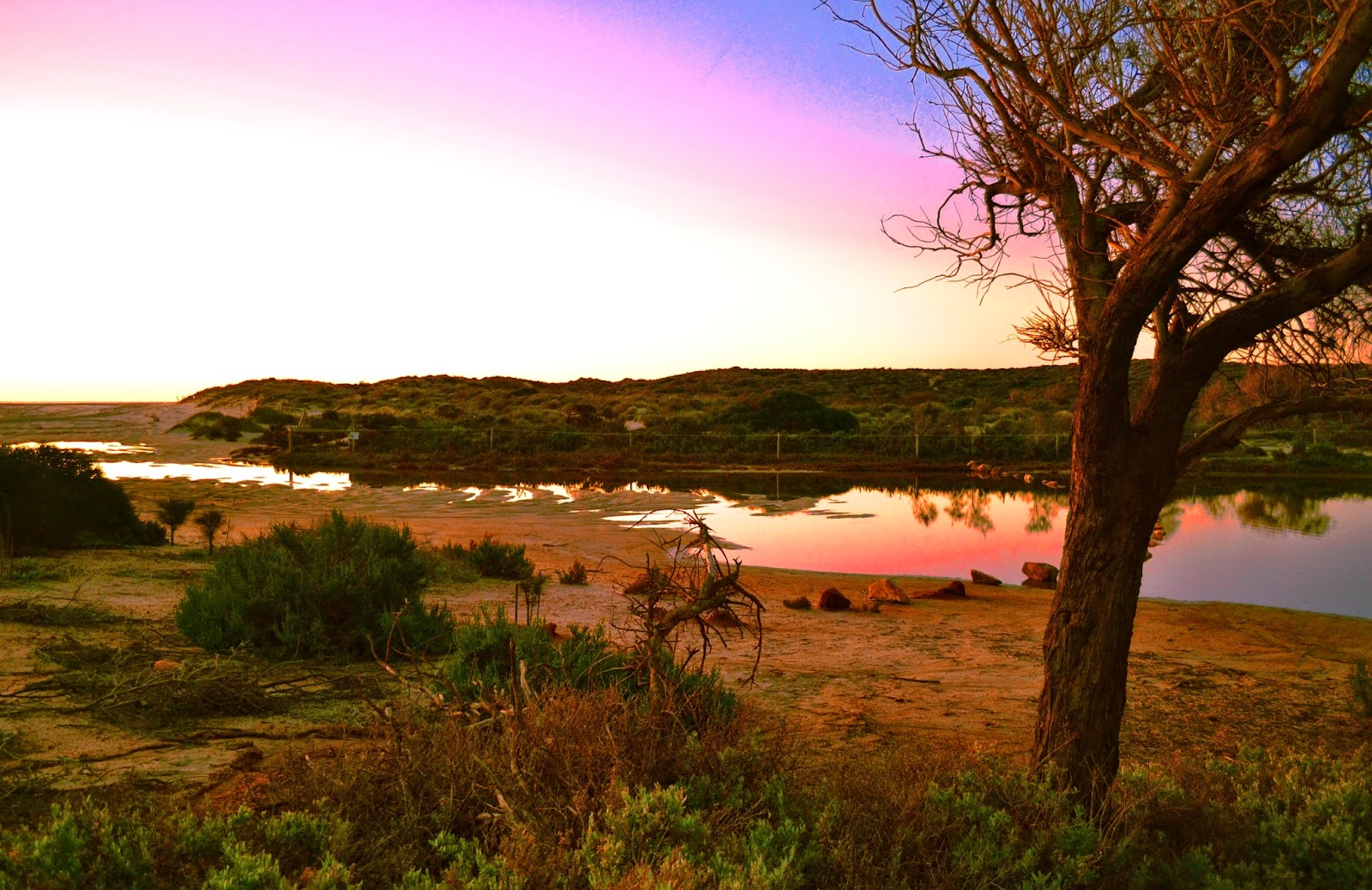
Wittecarra Creek
In another seemingly impossible twist of fate, some of the survivors managed to escape to a nearby sandbar and very narrowly managed to hail the captain first upon his return and explain the situation. Cornelisz and his top henchmen were hanged on the spot and others were shackled and transported back to Jakarta for trial and ultimately, hanging.

 For reasons unknown, Pelsaert took pity on two of the younger offenders and delivered them to the mainland, on a stunning but desolate stretch of beach just outside of present day Kalbarri.

Today a small out-of-the-way stone monument commemorates the occasion. It is just a hundred meters or so down a dirt track marked only as Wittecarra Creek. There is a single parking space and the track gives way to sand before it peters out on the beach. You'd be lucky to stumble upon it if you didn't know to look for it.

As most people know, Australia later became a British penal colony (the Dutch lost interest in Australia after a few too many expensive and deadly encounters with the aforementioned coastal hazards) but the irony that the first two permanent white settlers in Australia were of criminal stock did not escape me.

No one knows what happened to our two young sailors. Whether they lived out their days fishing and enjoying the glorious sunsets of Western Australia, died of starvation or thirst or fell in with some friendly or unfriendly Aborigines is unknown.

Australia is full of this kind of stuff. In the words of Roman Mars, Always Read the Plaque.


Tuesday, 24 June 2014

Kalbarri Redux

We've just spent a few fabulous days in Kalbarri, Western Australia. This trip wasn't breaking new ground for us, we were here about five years ago. But the opportunity to return to far flung places is a real luxury and last time we were here, we didn't have nearly enough time to do it justice.

In Western Australia terms, this place isn't particularly far flung. We are a mere 6.5 hours north of Perth. Western Australia covers an area roughly the same size as the continental United States from the Rocky Mountains to the West Coast, that's a big space.

Even more astounding is that the entire population of Western Australia is only 2.5 million people - and 1.7 million of those people live in Perth, leaving a mere 800,000 people dotted around the rest of state. For a bit of context, that's like if the population of Utah was spread over the entire western 1/3 of the United States. Western Australia makes the American West look and feel crowded.


Back to Kalbarri. Kalbarri is a hokey little town with 2 pubs and about 3 fish and chip shops. You can get a decent cup of coffee and there is a moderately well-stocked supermarket. Everything you need for a few days exploring and not much more.

Like so many other places in Western Australia, I'm sure that if Kalbarri was located anywhere else it would be world famous. Sure, the population of town swells in the summer months and there is a steady trickle of grey nomads the rest of the year, but it's hardly the worldly destination that it would be if it weren't so remote. This suits me just fine.

Kalbarri is planted at the mouth of the Murchison River where it empties into the Indian Ocean. The Murchison River has carved out  a stunning series of gorges that makes up the bulk of the National Park.

This trip we managed to complete the 9km Loop Trail that plunges down into the gorge and follows the sandy banks of the river before it turns into a (at times poorly) marked trail that leaves you scrambling along precarious weathered red rocks hanging over the river. Eventually you make the steep climb out of the gorge and follow the relatively narrow ridge of the gorge wall (about a 150 meter drop down to the river) back to where you started. It's a brilliant class 4 (out of 6) hike and suggests 3.5-5 hours to complete it. We did it in 3 hours with a lunch break. It would be a punishing trip in the summer when temperatures can soar to 50C/120F. We did it in a mild 16C/60F.

The other big attraction at Kalbarri is the stunning, and I do mean stunning, coast line. A dramatic stretch of bright red cliffs follow the coast south of the town and to the north 200km of sandy dunes stretch all the way to the World Heritage area of Shark Bay. There are numerous paths and lookout points along the coast, or you can do as we did and ditch the trails and (cautiously) climb along the cliffs.


The surf along this stretch of coast is relentless and provides a steady stream of brilliant turquoise waves. Year-round it is pretty easy to spot dolphins, whales and seals (we've seen all of the above this trip) but if you miss out on the local wildlife, the local surfers make a pretty good consolation prize as they gather in the late afternoon to show off their skills as the brilliant sun slips into the sea.


Thursday, 12 June 2014

On the Road Again

Badly needing a break from the city and taking advantage of a holiday weekend (the Queen's birthday, although not actually the Queen's birthday . . .) Anyway, we left Catface in the capable hands of the teenager upstairs (who was only too happy to binge on Netflix and try to woo Catface all weekend) and hopped a flight up to Brisbane.

Fully embracing his wannabe inner-Aussie, Ian has been dying to hit the road in campervan. Second only to surfing and consuming alcoholic beverages outdoors, road-tripping in a beat up VW Microbus or campervan is about the most quintessentially Australian activity in which one can participate.

Unfortunately for us, we don't own a VW Microbus and renting campervans is not as cheap as it should be.  By time you factor in the extra fuel consumption, campsite fees and rental costs you break even with cheap flights and basic motels. However, given the long distances that people frequently cover in Oz, there are a lot of one-way rentals which means they need to get back to their place of origin.

Hello campervan relocation schemes! If you've got a bit of flexibility and can plan at the last minute, you can get a one-way relocation deal which usually means you get the campervan for $1 a day so long as you get it back to the home city by the required date - the best deals even include a fuel allowance.

Anyway, Ian managed to get a Brisbane to Sydney relocation on the Tuesday morning and by Friday morning we were headed for the airport. We had a fab night out in Brisbane where everyone is super fit and falls into one of two categories - hipster or homeless chic.


Early the next morning we collected our wobbly wheels and knocking barely 2 hours and 200 kilometres off the 11 hour/1000km journey home we nipped out of Queensland just back over the border into New South Wales and parked ourselves at the Brokenhead Holiday Park at Byron Bay for the next two nights. (*No one availed themselves of the Chemical Dump Point during out stay. Phew.)

In this fairly populous corner of Oz, beach camping and sleeping in laybys etc. is strictly prohibited and even more strictly enforced. So we joined dozens of other holidaymakers who also had the brilliant idea to live outdoors less conveniently and practically on top of each other in what some countries would probably be considered a well-organised refugee camp. This desire to camp in such close quarters with complete strangers has always slightly baffled me, but Australians are so good-natured that within about 10 minutes you're best friends with your new neighbour as you stand outside with a beer admiring each others wheels and swapping traffic notes.


Byron Bay is a big destination in Australia - and rightfully so. The scenery isn't as dramatic as some spots along the West Coast, nor does it feel particularly remote (because it isn't), but it is still undeniably beautiful.

Given Byron Bay's huge popularity two things struck me immediately:
  1. There are virtually no permanent structures on any of the beaches in the area. A few have tasteful holiday cottages owned by the Park Service, but even they are set back into the treeline enough that they are barely visible. No concrete monstrosities here. Amazing.
  2. We did not see (and I do not exaggerate) a single piece of garbage or litter the entire time. If Switzerland had a coast, this is what it would be like.
To be honest those two factors alone were more than enough to win me over, but the hikes and beaches are pretty stunning too.
After two surprisingly comfortable nights in our van and far too much red wine and red meat we began our journey back south. Our plan was to do the rest of the journey in a single blitz, but we did want to make a quick detour just south of Coff's Harbor to check out the fabled Waterfall Way.

Considered a top scenic drive in NSW, this route is more Ferngully than Baywatch and makes for a pleasant if abrupt change of scenery. Turning away from the coast you head into the hills of Australia's Great Dividing Range (it's not as dramatic as it sounds, more Appalachian than Rocky) but the route shoots you into the Gondwana Rainforest - a World Heritage Site and the most extensive subtropical rainforest in the world. Unfortunately our exploration time was pretty limited, but we did head into Dorrigo National Park to check out the Rainforest Centre and even squeezed in a quick 3km hike to one of the Park's prize waterfalls (we'll be back for more in the future).

All too soon we were back on the road and headed south as clouds gathered over the distant Pacific and the sun set behind the hills of the Great Dividing Range.

Friday, 23 May 2014

Whaling around town

Unobliging wolves in Yellowstone, unwilling orang-utans in Borneo and uncooperative tigers in India - we have some experience of the local wildlife refusing to put in an appearance at the required time and place. So when we set off for North Head (a hamlet of Sydney Harbour National Park near Manly) for a bit of whale watching on Wednesday afternoon, our expectations weren't too high.

It was an area we'd been meaning to check out anyway as it offers stunning views out over the South Pacific and back to the city. But it's also migration season for Humpback and Southern Right Whales (they are headed north to the Coral Sea for the summer) and several had been spotted off of Bondi Beach just a few days earlier. It was a beautiful day - nearly 80 degrees and even the light breeze off the Pacific still had a touch of summer warmth.

As promised, the views were stunning. I'm still a bit in awe of Sydney and can't quite believe we live here:

View from North Head, Sydney Harbour National Park


I digress. So we found ourselves at North Head and after a few moments of gawking at the city, we headed for the ocean-side lookouts. Being a weekday afternoon, it was quiet with only a sprinkling of tourists, suicidal-looking guys in suits and a few retired couples milling about. 

We didn't have to wait long. Not hardly ten minutes after our arrival, a spout of water shot up from the surface. It was a mildly breezy and there were a few white caps on the water, but this looked distinctly different. We held out breath and waited. A few minutes later something big broke the surface and we couldn't hardly believe our luck. 


This whale wasn't in much of a hurry and was still quite far away, we could see him/her clearly with the binoculars, but our camera lens couldn't stretch quite that far. Fifteen minutes later, it was swimming near the edge of the rocks almost directly below us and we could see him/her with our naked eye under the surface of the water. 

He/she splashed around a bit more and eventually graced us with a few full-breaches of the surface. Unfortunately, this is the best photo we got, but I assure you it was spectacular.

Occasionally, I worry slightly about my wanderlust and my (bad) tendency to get bored with a place before I've even had a chance to fully explore it. I don't think Sydney and I are going to have that problem, I think we are going to be just fine.