Saturday, 26 May 2018

Lapland

For years (and long before it was a permanent fixture on any social media bucket-list) I've wanted to visit Finnish Lapland. And so on the 18th of December (after nearly a year of scheming and planning), just three days shy of the shortest day of the year, we found ourselves disembarking at Ivalo Airport. At 11am the sky had a few streaks of the light (the sun would not come above the horizon for another month at least). It was -22 degrees and we were 150 miles north of the Arctic Circle.


After a beautiful drive through snow-covered forest we arrived and checked into our glass igloo for the night. It was toasty and warm and being completely horizontal for the first time in over 24 hours felt pretty amazing. Even in the afternoon gloaming with a few snow-drenched pines leaning just into our field of vision the view was stunning.

After a few adult beverages, snug in our igloo we focused on the sky above us and did see some pale flickering. Jet-lag in full swing, we (predictably) fell asleep and apparently slept through a rather stunning display of the northern lights. 

Never mind. We had  plenty more planned over the next few days of our stay. 

We kicked off our Arctic adventure with a reindeer safari led by a Sami (Lappish) reindeer herder from a nearby village. 

We bundled into a 2-person sleigh, lined with reindeer skins and set off through the forest towed by our trusty reindeer. It was a clear day, so the sky was fairly bright despite the fact that the sun had never fully risen. Every inch of every tree, bush, plant, shrub, was perfectly and completely coated and groaning under the weight of ice and snow. Even for someone who grew up with snowy winters, it was positively magical.


We all associate reindeer with the Arctic, but I had never really seen one properly up close or paused to think about how important they are to the people of the far north. 

At first glance, they don't look like hearty enough creatures for the climate. Their spindly legs look quite exposed and their fur completely lacks the length and lushness that you expect from an animal that survives in such a harsh environment. But try and run your fingers through reindeer fur and it is virtually impossible. It is so dense that you can't get your fingers through it and each individual hair is hollow and filled with air, essentially rendering reindeer completely waterproof. They are quite literally made of nature's own Goretex. 

They survive almost entirely on lichen, a sort of dry moss that hangs from the trees. Again, an unlikely food source that looks like a painfully meagre in the face of such an unforgiving environment. 

After our safari as we warmed up over hot-chocolate, in a smoke-filled lavvu (the Lappish equivalent of tepees used by Native Americans) our Sami guide told us about life north of the Arctic Circle.

Reindeer are essential to the Sami people - and to this day, the Sami are predominately reindeer herders. Collectively his village manages a herd of about 8000 - and they lose about 500 a year to bears, wolves and lynx. And while he now tracks the herd with his snowmobile - his father used to do so by cross-country skis - very little has changed.


 He still herds in his traditional Sami-reindeer skin boots that his mother made for him in the 80's. They are made of 3 layers of reindeer skin - and having experienced the warmth of reindeer hide gloves myself, I am fairly certain that his 30-year-old hide boots are as good as the best Goretex winter boots money can buy.

The Sami people are spread across the Arctic regions of Finland, Sweden and Norway - and would consider themselves Sami first, and Finnish, Swedish, Norwegian a distant second. Until the 1960's many Sami herders still lived in lavvus and the high north of Finland didn't have electricity until the 1980's.

It was a genuinely remarkable experience. It felt exotic, which for all the idyllic villages, crumbling castles, and towering cathedrals that dot the continent, exotic is not a term I often use to describe a European holiday, but this felt exactly that.

PS I began this post not long after we returned to Australia in January, it's only taken me five months to complete. 

Saturday, 9 September 2017

Visiting Trump's America

I boarded DL 41 from Los Angeles to Sydney late on Monday 7 November - just hours before polls opened on the East Coast for the 2016 US Presidential Election. I recall thinking with a touch of nostalgia as I passed through exit immigration, that no matter what the outcome - it would be the last time I would see a photo of a smiling Barack Obama on the wall behind the un-smiling immigration agent.

Twelve years I've been living abroad now, and I've been coming and going from USA at fairly regular intervals ever since. And for the first time ever, I'll admit I had some anxiety about my trip home - my first trip to Trump's America.

In all these years, I have only ever observed relatively modest changes between visits - better beer (or maybe I just have better taste now), the proliferation the of gluten-free industrial complex and toddlers with personal cell phones.

But when I visited in July of this year, I really did expect America to feel much different. And if I'm completely honest, it felt mostly like the America that I know so well: security guards dressed like storm troopers at suburban supermarkets, everything (that wasn't furniture) in my hotel room was for sale, and lots of neon-orange plastic cheese (for which I have a secret soft-spot).

It has taken me awhile to process this trip and my thoughts change daily alongside the breaking news. When I arrived back in Australia in mid-July, I had come to the conclusion that I was both relieved and a little impressed that people seemed to be bravely soldiering on despite the fact that Donald Trump occupies the White House.

But, there was also a tiny part of me that was a little appalled that it seemed to be business as usual - I mean Donald Trump is POTUS. I live 9,852 miles and 14 time zones from Washington DC and I'm freaking out. Daily.


Then Charlottesville happened.

And worse than being appalled, I was utterly un-surprised.

And that was when the unsettled feeling I had about how 'normal' America had felt came creeping back.

Now, Donald Trump is not personally responsible for Charlottesville.

If we are passing around blame, and let's face it, there is a lot to go around. The Republican Party takes the lion's share. The Republican Party has undeniably made the current situation 'normal'. They have been building towards this moment for years. Aiding and abetting the worst instincts of white America, every single step of the way. Voter fraud. Gerrymandering. Birther-ism. The list goes on.

Donald Trump is nothing more than a startlingly accurate caricature of everything they have embraced and who has turned out to be far more than they bargained for.

And don't start lecturing me on the plight of the white working class. I've heard it. I get it. I really do. I am a product of rural, white, middle America. This is just so much bigger. Quite literally according to Mother Jones:
Based on preelection polling data, if you tallied the popular vote of only white America to derive 2016 electoral votes, Trump would have defeated Clinton 389 to 81, with the remaining 68 votes either a toss-up or unknown.
So.
Do I think that everyone who voted for Trump is a dyed-in-wool racist? Of course not.
Do I think everyone who voted for Trump advocates sexual assault? Of course not.
But do I think if you voted for Trump, you did exactly as the Republican Party has been doing for years, and say: I have no fucks to give about anyone but myself? You're goddamn right I do.

White America, we fucked up. We fucked up bad. And we've been fucking up for a very long time. In his recent article, The First WhitePresident, Ta-Nehisi Coates, sums it up better than I ever could:
And so the most powerful country in the world has handed over all its affairs—the prosperity of its entire economy; the security of its 300 million citizens; the purity of its water, the viability of its air, the safety of its food; the future of its vast system of education; the soundness of its national highways, airways, and railways; the apocalyptic potential of its nuclear arsenal—to a carnival barker who introduced the phrase grab ’em by the pussy into the national lexicon. It is as if the white tribe united in demonstration to say, “If a black man can be president, then any white man—no matter how fallen—can be president.”
And before you puff yourself up into righteous indignation, I'm not schilling for the Democratic Party or even the left. I was never crazy-go-nuts for Hillary and liberals (real ones, not these safe-space, anti-free-speech pretenders) need to get their shit together. I'm looking at you, Southern Poverty Law Center.  But let's save that for another time.

So back to my original point. I've been to Trump's America and I will return to Trump's America, but next time I really hope it feels different. The right kind of different.

Or even better, let there be a new smiling face behind the un-smiling immigration officer.

Please just don't let it be Mike Pence.


Now, go grab ’em by the pussy America, and sort this shit out.

Thursday, 20 July 2017

The Red Centre

Just because I've been on a long hiatus doesn't mean that we haven't been up to loads of exciting stuff. It's just that adulting really gets in the way.

Excuses made, one of our favorite recent-ish adventures was a three-day jaunt to the desert to get a good look at that giant rock that everybody goes on about.

I can see how visiting Uluru (formerly Ayers Rock) is one of those destinations that give people pause. It's expensive, it's a big rock, it's in the middle of nowhere. I was once such a sceptic, but if you asked me now, 'Is it really worth it?' I would give you a resounding, 'yes'.


We took gamble and visited in December, the hottest and wettest time of the year. The average daily temperature in summer is 38C/100F and 47C/116F is not unusual. There is almost literally no shade and most hiking trails close at 10am this time of year. The well-posted warnings about heatstroke/water/sunscreen are truly dire. The Australian outback is an inhospitable place, even if you're barely venturing 30 miles from the hotel pool.

However, braving the heat has its rewards, not only is it less crowded (Uluru receives about 250,000 visitors annually) but during this time the waterfalls streaming down the sides of Uluru are in full-flow and the sunsets are beyond spectacular.


The fun begins upon arrival at the tin shed that passes for an airport, where you are greeted with this:

Unfortunately, we did not encounter any dingoes
It's a short ride from the airport to the resort and from a distance the resort resembles a semi-permanent refugee camp in the middle of nowhere. This is not the kind of attraction where you pull up, toss your keys to the valet and find yourself just a few steps from the rock.

Uluru is a very sacred place for the Anangu, the local aboriginal people, and to have any man-made structures interfering with the landscape would be a tremendous affront. As a result, the resort is a nearly 20 minute drive from the National Park so there is no disruption to the landscape. Whoever came up with/instituted this policy is a national treasure.

Uluru has been a National Park since the late 1950s but control of the land was given back to the aboriginal community in 1985. Since then the Anangu have leased the lands back to the National Park Service and it is currently jointly managed between these two groups.

Back to our adventure.  So Uluru is big. Really, really big. The circumference is nearly 6 miles around and the only way to really take it in is to walk or cycle the base (we cycled, 10/10 would do again). From a distance you'd never see the waterfalls and 5000 year-old ancient rock art (no photographs please). Pardon the analogy, but Uluru is a bit like looking at an impressionist painting. From a distance, it appears quite uniform and coherent, up-close, it's a total mess.


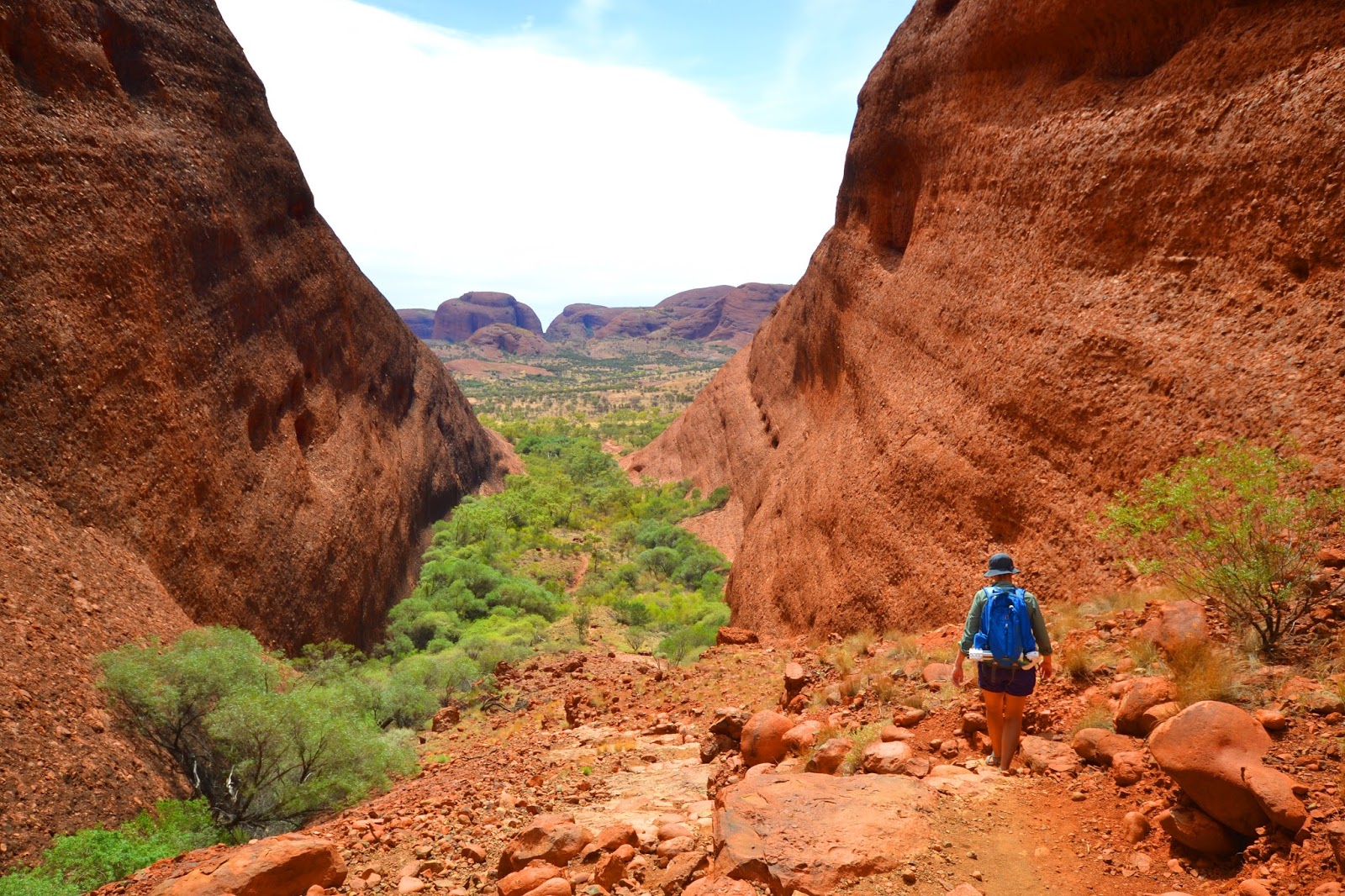
If that isn't enough to convince you it's worth the trip, perhaps a trek down the road to the lesser-known, less crowded, but (controversially) in my opinion, even better Kata Tjuta (formerly The Olgas) will do the trick.


More big, old (like 550 million year-old), red rocks, yes - but due to weather patterns Kata Tjuta has endured more wind erosion, hence the greater variation in size and shape. Also, if you're itching to get your hiking boots on, this is the place to do it.

While you can technically climb Uluru, it is not only dangerous but extremely disrespectful to the aboriginal owners and these days very few people attempt to do it. Kata Tjuta, on the other hand, has a fully-sanctioned 7.4km circuit hike that takes you into the heart of the landscape and is handily one of the best hikes I've ever done.


While the rocks in and of themselves are staggeringly impressive, it's the overall landscape that completes the experience. As anyone who has spent anytime in the American Southwest will know, there is something almost intoxicating about the sheer space of it all. In a space like this it is dangerously tempting to load up a 4WD and carry on until you run out of road.

Just don't forget your fly net, the flies really are far worse than you can imagine.


Sunday, 11 October 2015

Tales from the South Pacific: Part II

It never ceases to amaze me how many people go on fabulous holidays to exotic destinations and then never venture further than a 10 mile radius from the airport.  People will happily spend nearly an entire day and hundreds if not thousands of dollars to transport themselves to this wonderful place - and then barely venture beyond the confines of their resort. They return home and tell everyone that they've 'done' (insert Bali, Thailand etc. here) and ramble on about the authentic, trans-formative cultural experience they had without ever leaving the confines of the local Hilton. This experience usually involves the trials and tribulations endured whilst explaining to the completely non-plussed local waiter that they are 'like, totally gluten-free'.

I get it, sometimes you just need room service and a good concierge, but on the whole I find this a bit perplexing, I can get those things without the hassle of leaving Sydney.  Anyway, those less adventurous than ourselves do us a great favor by leaving us in peace to ditch the crowds and get off the beaten track. Vanuatu is primed for this sort of travel - the tourists come in droves and never make it beyond greater Port Vila. This is a missed opportunity.

With the pilot who safely got us from Tanna back to Port Vila
Lured by the promise of an active volcano, cargo cults and remote island paradise we set our sights on Tanna. There is at least one flight a day from Port Vila down to Tanna, sometimes two. If you're lucky Air Vanuatu will be running the 'big' plane an old French ATR turbo-prop which carries about 50 crew and passengers.  If you're unlucky, like we were, you'll get downgraded to an 8-seater prop plane that to my horror was roughly the size of our car and looked significantly less sturdy. 

The day before our departure I dragged Ian to the local Air Vanuatu office to see if there was a larger plane operating and if we could change our flight. The man at the Air Vanuatu office snickered at my request, but dutifully looked up the flights and let out a soft chuckle. 

No, there most certainly was not a larger aircraft operating that day, the only other plane on the route was smaller still. I asked him how old the plane was, he said it was probably from the 1960s. Seeing the horror on my face he assured me that the engine was quite new and the pilot knew the way. We left and I congratulated myself for packing a small stash of Valium.

I've seen some pretty sorry airports in my day, but the airport at Tanna almost certainly takes the top prize. 


The immediate area around the airport and main village at Lenakel have mains power and running water - venture much beyond and you are plunged into total and complete darkness after sunset. We arrived just as the sun was starting to fade and despite having re-confirmed with our 'accommodation' our flight number and arrival time just the day before; there was no one at the airport to greet us. Our fellow passengers dispersed quickly and it was clear the airport was about to shut for the evening and we had nowhere to go. 

Sensing our dilemma a local man approached us and we explained the situation. Without batting an eye (or asking is friend), he assured us that his friend would take us where we needed to be and if we stayed much longer we'd be sleeping on the tarmac. 

Now there may not be much in the way indoor plumbing or electricity on Tanna, but there is a damn good mobile phone signal and by this time Ian had managed to get ahold of our accommodation who were (rightly) hugely embarrassed that they had forgotten to collect us.  We put our saviour on the phone with the proprietor and lacking any alternative option we hopped into the well-worn pick-up truck and were on our way.

Tanna is tiny, just 25 miles long and 12 miles across yet the drive from the airport to the other side of the island takes nearly 2 hours. This is true 4-wheel drive territory, rarely going more than 10 miles an hour it is a stunning, if bone-rattling journey to the other side.

Not ten minutes into our journey the truck pulls over and our saviour jumps out, assuring us that his mute friend would get us to our destination. Ten minutes later we pull over again and pick-up a band of rag-tag locals, most of them settling into the back of the truck with our gear and a rather alarming-looking man with ashy skin and horribly blood-shot eyes slid into the front seat and began chatting away to us. (We later learned that these are the tell-tale signs of a serious kava addiction).

After several more phone calls, a few scary reversals down steep tracks, fording a small stream, and driving across the ash plain of an active volcano we turned down a nearly invisible path in the pitch black, our junkie friend announced our arrival.

Now, I'm not going to lie, it did briefly cross my mind that this might be a sticky end to an adventure gone horribly wrong. We were certainly about to be robbed and hacked to pieces with blunt, tetanus-riddled machetes never to be heard from or seen again. 

No sooner had this horror story crossed my mind than a few flashlights came bobbing through the darkness. I had a few choice words that I'd been rehearsing on the drive for the manager but he was so apologetic and kind that my irritation quickly melted and I chalked the whole mishap up to an 'experience.'

We were shown to our room, a tiny bungalow with just a bed and mosquito net. Ian fished out our flashlights and battery packs, I fished out the bottle of wine that we had so wisely stuffed in the suitcase and we sat on the stoop of our bungalow, sipping wine out of plastic cups enjoying a crystal clear view of the Southern Cross without the slightest idea of what might lie ahead.

Saturday, 10 October 2015

Tales from the South Pacific: Part I

Back by popular demand, an introduction to our completely bonkers trip to Vanuatu.

One of the most exciting things about living in Australia, is that it puts a little-known, little-visited, corner of the world within relatively easy reach; the tiny and remote island nations of the Southwest Pacific Ocean.

This was our first foray into the South Pacific, and we have been positively smitten. 

Now, I pride myself on my geographic prowess but even I had to get out a map to pinpoint just exactly where Vanuatu is - the Pacific Ocean is a big place. Here's a map of the region to put into context just where it is in relation to Australia and surrounding island nations:

Vanuatu was in the international spotlight briefly last year after the capital city Port Vila and many surrounding islands were hit hard - very hard by Cyclone Pam (more on that later). After this brief burst of international attention Vanuatu faded back into it's usual state of international anonymity.

Vanuatu has only been an independent nation since 1980, and has a long history of colonization and foreign visitors - from Captain Cook himself to the US military in WWII. Vanuatu's importance during the War as an American military base is a footnote in most chronicles of the South Pacific campaigns and lacks the name recognition of other famous places like Midway, Iwo Jima and Guadalcanal

In fact, Vanuatu played a key role in the battle of Guadalcanal.  Vanuatu's only international airport (at Port Vila) is called Bauerfield Airport and is named for the American Lieutenant Colonel Harold Bauer, who worked with locals to oversee the creation of the landing strip that was a major base for air operations during the battle. Guadalcanal is just 600 or so miles north of Vanuatu in the southern Solomon Islands. Lieutenant Colonel Bauer was later shot down by the Japanese about 100 miles off the coast of Guadalcanal in late 1942 and never found.

No longer required for military use, the now paved runway brings flocks of tourists to Vanuatu from Australia and New Zealand. There is a small memorial to Lieutenant Colonel Bauer in a dusty, neglected corner of the international terminal at the airport.

John Frum followers raise the American flag in as part of their daily ritual
Meanwhile, south of Port Vila on the island of Tanna, the American soldiers were a particularly big hit with the locals and gave rise to the Cargo Cults that still exist to this day. John Frum (as in John From America) is the largest and most famous and still raises the American flag at dawn each day. Awed by the sudden appearance of previously unseen and completely incomprehensible modern toys - from airplanes to Coca-cola the locals understood this to be some form of divine intervention.

After the war and the foreigners returned home the cults built and maintained airstrips, control towers (complete with coconut shell headphones) and thought if they were just patient enough and if they could get the spells right, the foreigners would return with all of their goodies. (More on our Tanna adventure in the next installment).

After the War the Brits and the French hung around as the colonial administrators until 1980, as a result French and English are widely spoken today. The tribal dialects are vast and diverse but there is a national language - perhaps more accurately described as a patois, it is essentially a pidgin English called Bislama. If I ever decide to take up a foreign language, this will be it - we had great fun attempting (often successfully) to translate for ourselves.

Vanuatu is tiny. The CIA lists 230 nations and territories in the World Factbook, and when ranking by physical size little Vanuatu comes in at #164. Vanuatu comprises roughly 80 islands (65 of them inhabited) and the total area is just larger than the US state of Connecticut.

Check out the Bislama slogan.
The total population of these islands barely makes up a small city - with the total population sitting at just over 270,000 people - approximately 53,000 people live in the capital Port Vila, which is by far the biggest city. If ranking world countries by population, Vanuatu comes in at  a lowly 183.

Given its tiny size, tiny population and remote location - it's not surprising that Vanuatu is a relatively poor nation, with an average annual income of around USD $2,600 per person. Despite it's general poverty, there is virtually no  evidence of homelessness, starvation or outright destitution. It is without question one of the safest and friendliest places I have ever visited.

It's not a culinary destination as the food available is largely confined to what can be grown locally or pulled from the sea. There is a national beer - Tusker - which I can testify goes down very nicely just about anywhere or anytime.

More on our actual adventures next time.


Thursday, 11 September 2014

Ode to Tasmania

It wasn't a trip that I thought I'd squeeze in this year, but a combination of cheap flights and the prospect of a lonely week home alone conspired to make it happen. Jittery with anticipation, I returned to Tasmania for the first time in just over 15 years.


But first, let me back up a bit. I caught the travel bug at an inappropriately young age. My sister and I were carted around on a lot of lengthy domestic roadtrips, usually to to visit one of my mother's seven siblings. A few of my uncles had the good grace to live outside the geographical confines of the Midwest, but unfortunately no one lived in Florida. 

In retrospect, I owe my mother a hearty thanks for bypassing Disney World and Florida altogether. I was in Orlando for a conference last year and it was hell on earth. I've been put out with Florida since the 2000 election anyway and the cross-section of humanity at the Orlando airport did little to raise my opinion of the place. In lieu of Disney, it was the likes of Mount Rushmore, the Alamo and countless day trips to Chicago. I am eternally thankful.

At age 16, I somehow managed to convince my mother that it would be an excellent idea to let me go to Australia for a summer and live with complete strangers. (I seem to remember pushing for Africa, but she put her foot down - as a nurse I think she was more willing to risk a tango with the wildlife in Oz than disease in Africa.)

Fifteen years later, it's still one of the best and most formative experiences of my life. Those complete strangers I lived with are five of my favorite people on the planet - all five of them hauled from around the world to attend our wedding in Chicago in 2011. Their car (Nia, Adrienne, just in case you are reading - I haven't crashed) is currently residing on our street Sydney. I'm so lucky to have been placed with such a generous and special family - so a huge part of my trip back last week was to catch up with some of the wonderful people I met 15 years ago. (Insert here massive thanks to Tanya and Shaylyn - tour guides and chauffeurs extraordinare!)

Okay, enough of the soppy stuff. Tasmania is seriously beautiful. Of course I remembered it as beautiful, but I had forgotten just how truly stunning it is. This is a special place. In fact, it's tempting to just quit writing and let my photos do the talking. For real.


My memories of Tasmania were a bit fragmented, there were things I remembered distinctly and other things I had no recollection of; but on the whole I am delighted to report that Tasmania seems (to me anyway) to have changed remarkably little. It is a working class island, dominated by forestry, fishing, mining and tourism. The buildings are tidy and utilitarian and to a city dweller even the larger towns feel distinctly rural. As someone who grew up in small-town, middle-America, this is a place where I feel very much at home.

Life moves a bit slower in Tassie and although distances are short, the roads are windy and narrow. It takes time to get around; but with virtually every hairpin turn offering another stunning vista across the sea, forest, rolling pasture or mountains - the long car rides don't bother me in the least (motion sickness aside).


Suffice it to say that this is a place worth making time for. I can't guarantee that you'll get four glorious days of unrelenting sunshine like I did, but it's still well-worth the trip. 

Wednesday, 10 September 2014

Baby (erm Scotland), Please Don't Go

Hiking in Glencoe, 2009
I'm just returned from a glorious 4-day stint in Tasmania, but more about that later. The upcoming Scottish independence referendum has been much on my mind lately. I lived in Scotland for four wet, windy, wonderful years and while in Tasmania this week, I was seeing Scotland at every turn.

Tasmania and Scotland share more in common than just good looks. Both are occasionally forgotten outposts of a larger nation. Tasmanians talk about the 'mainland' and 'mainlanders' much the way Scots frequently talk about their southern neighbors - with mingled disdain and reverence.

Both are places where it is truly possible to leave the hubbub of modern life behind. You can still hear snatches of Gaelic in the highlands and islands of Scotland and Tasmania has no international airport; it is the kind of place where you can still rock up to the airport just 15 minutes before departure.

These are all wonderful things; and Tasmanians and Scots alike are justifiably proud of the beautiful, unique and quirky place that they get to call home. But they are also an integral, and I dare say essential, part of a larger collective. Australia would not be Australia without Tasmania, much as I find a United Kingdom without Scotland unfathomable.

I find it upsetting enough that England, Scotland, Wales and N. Ireland maintain separate teams in the World Cup and Commonwealth Games (but not the Olympics - please someone explain?!?) And that is just sports that I don't even care about; I can't imagine how upset I'd be by an actual divorce.

I have sympathy for the independence movement - I don't like the Tories much either. But I can't help but feel that this is largely what this vote is about or has become about; it's an anti-Tory referendum. It feels a bit petulant, a lot of people south of the border don't like Cameron & Co. and still bear the same scars of Thatcherism.  The vision of an independent Scotland spun by the left-leaning, socially-minded Scottish intelligentsia (see wonderful article by Irvine Welsh) is alluring, if hopelessly romantic, overly optimistic and disconcertingly quiet on the issue of currency and economy.

St Andrews
And further, the values, hopes and ambitions espoused by the gentle left are hardly those of Alex Salmond and his cronies who will, in fact, inherit the throne (so to speak). The political difference between the entrenched Labour elite and Alex Salmond's SNP is nothing more than the location of an office in Westminster versus Edinburgh. In an independent Scotland the new politics will quickly become the old politics; Alex Salmond is already taking Rupert Murdoch's phone calls.

I'm not an economist (by any stretch) and I want to keep this light, but suffice it to say that the economic nirvana envisioned by the Yes Campaign will be difficult (impossible?) to achieve whilst tethered to the her majesty's pound and their Bank of England overlords.  Paul Krugman put it rather more eloquently (and in far more detail), but the gist of it was, currency control is everything, just think about the state of the Spanish economy . . .

We left Scotland just as Alex Salmond was becoming a household name - North and South of the border. I think he is smart, sly and has masterfully manipulated the unpopularity of a Tory government for his own political ends. I have no personal stake in this vote and we left Scotland nearly five years ago now; but aside from my home town, it is the place I've called home the longest.

My husband is a half-caste (firmly in the 'No' Camp and proud of his Scottish heritage) and we're both graduates of the University of St Andrews. At 601 years it is third oldest university in the English-speaking world and pre-dates the Union of the Crowns by nearly 200 years - clearly Scotland was doing pretty well before they wedded England and I see no reason to think that an independent Scotland would not eventually succeed. But, I do think the post-independence road will be much harder than many are prepared to admit.

Regardless of which way Scotland goes next week, I wish Scotland nothing but success and prosperity, but I do hope they decide to stay.

Sunday, 31 August 2014

It finally happened.

So this finally happened. Emergency landing a plane over a couple bits of plastic and a cup of water seems a bit extreme to me (and the only people I really feel sorry for are the delayed fellow passengers of the offenders). I've written previously about how unreasonable people are when it comes to spending a few hours in the air and don't expect anything to change short of a mandatory dose of Ativan for all passengers before take-off.

I'm sure you'll be surprised to know that I have a strong opinion about the Knee Defender. I think it should be banned outright (and on most airlines it is). Most of us know what we are getting into when we fly and I think the Knee Defender is pathetically passive-aggressive and downright selfish.

I would also like to know why tall people get the monopoly on flight discomfort? I'm not particularly tall or large - I'm pretty much exactly average, so I accept that certain aspects of flying are more comfortable for me than others. But. I do get bad lower back pain - particularly when I stand or sit in the same place for long periods of time. On long-haul flights (and I do a lot of 8+ hour flights) I need to put my seat back just as much as the 6'4 guy behind me needs more leg room.

I think I'm a pretty conscientious flyer; I tend not to put my seat back on short-haul flights and I always put my seat up for meal service - but I do firmly believe that should I choose, the right to recline my seat is irrefutably included in the price of my ticket. From a purely logical stand-point, it is difficult to argue that an action that actively interferes with the design of someone else's seat trumps that of a person using their own seat as it was designed.

I'm not going to suggest that tall people either don't fly at all or fly business class; flying is frequently the only way to get from A to B and if flying business class was affordable, we'd all be doing it. I guess what I am trying to say is, can't we all keep our hands (and seats) to ourselves, have a drink and be miserable together?

Friday, 29 August 2014

Bros, Babes & Bondi

Seven months in Sydney and we finally hauled ourselves out to Bondi and the eastern beaches. Bondi is the city's most famous ocean-side beach and even in late winter it is a crowded crescent of sand where the bold and the beautiful come out to play.

This is where Australia's famous laid-back beach culture becomes a self-caricature. Bondi is the kind of place where bronzed bros strut around with gym towels draped casually around their necks as if a towel is a legitimate fashion accessory. Feel me, bro?

Smaller and quieter Bronte Beach

The setting is stunning; there is no denying that (although you might be distracted from the curvy coast by curves of another kind). The 10km coastal path that starts at Bondi and carries south to Coogee is a windy track that hugs the coast line; descending to small beaches and ascending to the tops of coastal cliffs along the way.

It's a well-trodden route, popular with tourists and locals alike. There's parents negotiating SUV-sized prams up and down the many sets of stairs; tourists stopping abruptly every three feet or so for yet another selfie; the doggy day-care folks wrangling packs of yappy dogs; the bewildered (us); and of course the fitness buffs.

Ocean swimming pool on Bondi-Coogee Coastal Path

Given the chaos on the path it strikes me as odd that this where anyone would choose to go for a run. The navigation required eliminates any chance of taking in the scenery and the stop-and-go nature of traffic on the path is enough to test the patience of a London bus driver.  It would also appear that lipstick, eye-liner and push-up bras are (rather impractically) all part of the workout uniform in this part of town. Maybe it's not really about the exercise after all; if you are young and fit, this is the place to see and be seen.

That said, it's all bit absurd, but harmless and the crowds start to thin once you hit Clovelly; a lovely spot with snorkeling and stunning views. For my part, I'm going to stick with Manly and the northern beaches where being over 30 isn't a crime and you can eat your fish and chips in peace without harsh looks of judgement.

Wednesday, 27 August 2014

Petty convenience, freedom & the welfare state

I can recall early trips abroad and tying myself up in knots over the lack of the petty conveniences that make up day-to-day life in America:

Haven't these people heard of air conditioning?
Can I get some ice please?
Whaddya mean everything isn't open 24 hours?

These are the things that you can hear travelling Americans complaining about loudly on golf courses around the world and these were the things that I missed when I first moved abroad too. However, I quickly discovered that in reality I had no idea what I'd actually been living without all those years. Ice in my drinks became irrelevant.

I moved abroad for graduate school, got an impractical masters degree from an excellent university, met a boy and never came home. Those first years of post-college adulthood are tough (wherever you are) - and I was woefully unprepared for them. Like many young graduates I didn't realise how much more actual experience is valued over where you went to college or what grades you received. I, inevitably, ended up in a string of jobs that I saw as 'beneath' me, but in retrospect provided exactly the experience that I needed.

It was hard - and it should be hard, but I also realised that so many of the things that my 20-something friends back in the US were losing sleep over, just weren't a problem for me. I had instant access to universal healthcare, that legendary European tax burden that Americans love to hate was actually less than it would have been in Illinois and I was accruing undreamed of amounts of paid vacation time.

I wasn't earning much more than minimum wage and my (now) husband was getting by on a PhD stipend, but it was enough to make ends meet.  We were eligible for a modest weekly tax-credit that made such a difference to us financially, that we're probably still feeling the ripple effects of it to this day. Demonize the welfare state all you want, but it helped to get us from struggling young graduates to productive, tax-paying members of society; seems like a pretty good return on investment to me.

Next week I commence year 10 as an expat and the things that I once missed about living in America now confound me. I get flustered with the military precision of the drive-thru; the amount of choice (and wastage) in grocery stores completely overwhelms me; and driving everywhere just leaves me in a semi-permanent state of carsickness.

We visit the US regularly and my (British) husband rarely fails to observe that you have the freedom to do everything in American except have fun. How true. You can take an assault rifle to the grocery store but can't legally enjoy a cold beer in the park on a sunny day.

Americans like to bang on about freedom ad nauseam, but in the UK and now Australia we are free to do so much more. We are free to take a (paid!) vacation; free to have a beer outside; free not to live in fear of guns in the wrong hands; free not to be denied healthcare because the freedom of a corporation trumps our own. We have free speech (but money is mercifully not free speech), free religion (or no religion), and certainly a free(er) press.

Don't get me wrong, there are many things I love about America and I believe that Americans are a genuinely smart, generous, an innovative bunch, that are trapped in a self-made political system that is held hostage by the highest bidder and lunatic fringe. I'm also not saying that everything in the UK or Australia is perfect; both countries currently have unpopular, centre-right governments with particularly bad education and environmental policies. Nowhere is perfect, but we are lucky enough to mostly (Malaysia was a bit of a black spot) live in places that match our values and priorities far better than America does or can at this point in time.

So sure, I will always believe that your first-world status should be called into question if you still have separate hot and cold water taps; but on the whole a few minor inconveniences are a small price to pay for the social safety net and well-being that comes with living in a society where those on the bottom - or those just starting out (like we were!) aren't left to flounder and struggle.  Ironically, living abroad is what has enabled me to achieve the so-called American Dream.

Monday, 25 August 2014

Why I don't want to live in America anymore

A question that I get asked a lot is some variation on: Do you miss living in America? Do you want to go back?

The answer is, no. And nothing sums up why better than this advertisement:


While I loathe everything about this commercial from his over-quaffed Aryan looks to his souless Pottery Barn house and smug (completely misguided) superiority; it does succinctly sum up exactly why I don't want to live in America any more.

America has a lot of seriously misguided priorities, but at the most fundamental, human level is the right to take some time off to go on a vacation (or staycation). Further, the insinuation that the rest of the world is lazy, is so ridiculous that I'm not even going to bother discussing it.

Here in Australia we are entitled to a legal minimum of 4 weeks + public holidays paid annual leave, although 5 weeks + public holidays is standard for the public sector. I know that entitlement in the US varies widely, but the fact that there is no legally-guaranteed minimum is enough to keep me out of the country. (Of course, Australia also has a minimum wage of $17.00+ an hour, legal entitlement to paid maternity leave, and a healthcare system where I don't lose sleep about bankruptcy over a broken leg.)

I personally know of American-based friends and family who have worked in high-level jobs requiring a minimum of a masters degree and they have had 1 vacation day per month that had to be taken within that month.  I've heard of people refused time off for their own wedding. I know that some employers in the US are more generous than others, but it is a cold, hard fact that we find it much more difficult to travel with or get visits from our US-based friends and family than their European and Australian counterparts. The Americans are squeezed for time down to the hour.

I have lived on the other side of the world for over 9 years, and I am certain that my generous paid-leave entitlements have left me with far more time to go home for long breaks and spend quality time with my family and friends - far more so than if I lived in California and had to squeeze in a flying visit to Illinois once a year.

I know that people have different priorities and if you want to work yourself into the ground and collect lots of stuff for the house that you're never in - to each their own. But study after study has clearly shown that workers with more paid time off are more productive, happier and more likely to stay in the job.

So, to the guy in the Cadillac ad - enjoy collecting your cookie-cutter junk, asshole, I'm going to go stop at the cafe, see the world and spend time with the people I care most about.

Oh, and thanks to excellent public transportation and the ability to walk places without having to cross a freeway, we don't need your Cadillac either.

N'est-ce pas?

Thursday, 21 August 2014

My favorite things about living in Oz (so far)

Bacon. 


As an American who served 5 years time in the UK, I've been drawn into more than one streaky bacon (good) vs. back bacon (less good) debate. Australia has a rather elegant (and obvious) solution to this problem: just serve both together in a single, delicious, meaty, fatty strip about two feet long (very good).

Happy people.


Australians are so good-natured and cheerful that you'd be excused for wondering if they were all accustomed to a good morning slug of gin just to get the day off to the right start. Seriously, these people are friendly and happy to the point of suspicion. Australia is known as the Lucky Country - and with good reason - there's the great weather, a booming economy, fabulous food, drink and some of the best cities, beaches and scenery in the world. What's not to be happy about?

Wine.


While some wine aficionados might lament the lack of availability of Old World wines (or in my case the odd California Zinfandel), but I'm having a terrific time working my way through a cache of fabulous Antipodean vintages. I'm partial to Margaret River reds, Tassie pinots and of course Kiwi sauvignon blancs, but we've still got lots of sampling to do.

Roadtrips.


Australia has several world-class cities, but for me it is the long, lonely stretches in between that make Australia so alluring. This map shows all the major paved roads in a country the size of the continental USA. There are huge swathes inaccessible by anything but 4WD and dirt tracks - even the vast majority of the paved roads are single lane.


If you are thinking of hitting the tracks, just make sure you're properly stocked with water, petrol, satellite phone and that someone knows where you are. Also, don't watch the film Wolf Creek before you set off; bad things can happen out there.

Coffee culture.


Australians may love The Queen and playing cricket, but happily for me they've traded in tea for the good stuff. Try and get a bad cup of coffee in urban Australia - I dare you. Want to know exactly what's going on behind the cafe counter? Day-long barista courses are a popular past-time and come with an official certificate. Even McDonald's boasts 'barista' made coffee. Stroll down the high street of any trendy suburb and every second shop will be a cafe offering an overwhelming selection of beans and brews to choose from. Just make sure you study up before your order, asking for a filter coffee will get you a look of pity and despair - flat white and long black are the order of the day.

Aboriginal Art 


I could fill a house with this stuff - if only I could afford it. There's an almost unlimited amount of fantastic art out there, from modern Rothko-inspired paintings to traditional fine arts of paintings on bark with natural pigments.


The more you know about a particular piece, the more interesting it becomes. Aboriginal art is highly secretive - some paintings are desert maps of watering holes decipherable only to a particular community. Other paintings reflect aboriginal knowledge of local plants and animals.  It's fascinating and beautiful stuff - now we just need to save up.


Tuesday, 19 August 2014

Four skyscraper hacks

I'm not great with heights at the best of  times, so the promise of a little liquid lubrication is one of the best ways to get me to the top of scary tall buildings. Parting with a few pennies for some liquid courage is also a great way to dodge hefty admissions fees to popular sights; at worst you break even on the cost of a pint or cocktail each and sometimes you even come out a few bucks ahead - here are a few of our favorite skyscraper hacks.

Marina Bay Sands: Singapore


I'm going to say this outright (and I'm glad that I didn't know at the time of my visit) but the Marina Bay Sands is owned by mega-Republican donor and all-round geriatric-baddie, Sheldon Adelson. So should you chose to visit, just know where your money goes . . .

But if you must . . . the Marina Bay Sands is reportedly the most expensive building in the world - and it looks it; it was finished in 2010 at the cost $5.5 billion. I am not going to lie, it is impressive and virtually overnight has become Singapore's most iconic building.

So, if you've already slung a few Singapore Slings at Raffles but are still a bit thirsty and hankering for a bird's eye view of the city, you could do worse than heading to the rooftop bar Ku De Ta. Yes, a pint of Stella will set you back about $20 (welcome to Singapore!), but that beats the hell out of $23 just for the elevator ride to the observation deck. So hop the elevator to the bar (and don't pay the observation deck fee) - that way you can assuage your guilt of lining Sheldon Adelson's pockets with a cold beer while you enjoy the view.

John Hancock Building: Chicago


Chicago is famous for many things; political corruption, pizza, gangsters, bootlegging and its skyscrapers - yes, Chicago had them first (sorry NYC).  While The Sears, erm Willis Tower is the tallest (it gets you get to the 103rd floor) and has that terrifying little skybox, it does not have The Signature Lounge.  The Signature Lounge at John Hancock gets you nearly as high - to the 96th floor of this Michigan Avenue icon and like the Marina Bay Sands, you can pay for a lift to the top, or you can ride free and have a cocktail at the other end - I know which one I'd go for. The toughest decision is whether to go in the daytime and enjoy the fabulous views across Lake Michigan or at night to take in the city lights.

The Stratosphere: Las Vegas


Daredevils can bungee jump or $18 will get you to the observation deck; but (I guess you're seeing a pattern by now) we opted for the free ride and splurged on a post-nuptial glass of champagne. The Stratosphere isn't the trendiest or most popular hotel/casino in Vegas, but you'd be hard-pushed to find a better view.

View from KL Tower

KL Tower: Kuala Lumpur


The Petronas Towers rightfully hold the title of KL's most impressive - and tallest buildings; but the problem with visiting the Petronas Towers is that once you are in them, you can no longer see them! It's also worth mentioning that a visit to the Petronas Towers doesn't get you any higher than the skybridge, tickets are limited and queues long. So, cheat and make time for a visit to the KL Tower instead. It's recently gone under a much-needed renovation and the cost of the lunch buffet is nearly the same as a ticket to the observation deck. It may not be a free lunch, but it's close.

And if you're really just wanting to ogle the Petronas Towers and being sky-high isn't a top priority, then KL has plenty of rooftop bars with lower, but still spectacular views - there's the Skybar at Traders Hotel, Luna Bar at The Pacific Regency and several others. Bottoms up!

Monday, 11 August 2014

My Un-bucketlist

In a world with an overwhelming number of weird and wonderful places to go, you have to pick and choose, short-list and long-list. Our travel priorities shift based upon where we are, what we have time for, which flights go where and the weather. This will be controversial, but secure in the knowledge that we are never going to get everywhere, here are a five big ticket places that are on the back burner for us:

The Great Wall of China.


Yep, I said it. I'm sure it's amazing, but truthfully it is low on my list. Selfies on The Great Wall almost outnumber baby photos on my Facebook feed and the overall impression I get is that of overwhelming crowds. Crowds are an inevitable part of travel, but a big part of my travel philosophy is built around beating the crowds. And speaking of crowds, I know a bit about how crowd control works in Asia - there is none.

I'm willing to put in extreme effort to get to some places, especially if I'm going to be rewarded by having a place nearly to myself when I get there. I generally like my travel to have some element of relaxation to it and there isn't much about China that strikes me as relaxing. This doesn't mean that I have no interest in going to China, but when we get around to it, I suspect our priority will be a long train ride to Lhasa, not jostling with crowds on the Great Wall.

Disneyworld, Disneyland and any international permutation thereof.


Controversial, I know. This is completely a matter of personal taste, but if you ask me to do a word association with 'hell on earth' then Disneyworld with hordes of screaming children, stressed adults, unforgiving humidity, unrelenting expenses, unending lines and kitsch versions of foreign places where I'd much rather be is what immediately comes to mind.

There was a brief period of my life (around the age of 10) when I was certain that I was the only child in America denied the right of passage of a trip to Disneyworld; how quickly that feeling passed. I like Finding Nemo and Toy Story as much as the next person, but I'm fine with my Disney experience to be confined to the big screen. I was less than a mile from Disneyworld last summer and curiosity didn't even get the better of me; the cross-section of humanity I had witnessed at the Orlando Airport was all I needed to see.  Besides, I get dizzy just thinking about those teacups and one of the biggest perks of not having children is the ability to go on vacation without them.

The Pyramids.


Egypt is pretty high on our list, but our dream trip would bypass Cairo and the Pyramids altogether and start at Luxor with a slow trip down the Nile in a felucca to Abu Simbel. I've dealt with a lot of third world hassle in my day, but the tales that I've heard about touts and tourist harassment at the Pyramids is enough to make my head spin even from the comfort of my home.

I also prefer the ancient image of the Pyramids that I have in my head, perched on the edge of the Sahara with no evidence of modern life; not litter blowing past like tumbleweed and a KFC peeking out in the background.

New York City.


OK, so this is cheating a little bit; I've actually been to NYC, but it was brief, a long time ago and there was little to induce me to rush back. I can hear your sighs of disgust already, but bear with me. To an extent big cities are the same everywhere and I've done a lot of big cities in my day (I'm equally unimpressed with Singapore). So sure, Central Park is nice but so is Hyde Park in London; New York has some great buildings, but nowhere near the architectural heritage of Chicago; New York lacks a stunning geographical setting like Seattle or Sydney; New York has fabulous museums but how much better can you get than the Louvre or Hermitage? And is there any place on the planet more disappointing than Times Square? Seriously.

Niagara Falls.


Nothing against waterfalls, but I'm holding out for Iguasu or Victoria Falls instead. Niagara strikes me as that uniquely American type of tourist attraction where you can drive thru-McDonalds and the falls jointly and have the full viewing experience from the comfort of your car in five minutes or less. That just isn't for me. It's also just a long way from anywhere else of major interest; it seems like a lot of work for little reward. I know, I'm a snob. 

Okay folks, that is it. Feel free to set me straight.
                        

Friday, 18 July 2014

From Morocco to Myanmar: My travel top 12 (so far)

A question I get asked a lot is, 'where is your favorite place you've ever been?' Choosing just one is literally impossible, but I've managed to get it down to a dozen. This list is short on major sites and singular monuments and big on places and experiences. Sometimes it's the journey and not the destination that makes a trip.

This is a list that will almost certainly change over time, we have a lot of work to do in South America, Africa and right here in Australia. But at this moment in time, here are my top 12 (in no particular order):

1. Getting lost in Essaouira, Morocco


Essaouira was our penultimate stop on a long, hard journey through Morocco; a dot on the map that broke up a long bus ride between Agadir and Casablanca. I was 23 and this was my first encounter with the third world and the Islamic world (these were the days before Easy Jet was depositing 'stag do's' by the planeload in Marrakech).

With no male travel companion, we spent a lot of the trip seeking solace on the rooftop terraces of our riads to escape the steady stream of sexual slurs and general harassment that had trailed us through Fez and Marrakech. We dressed conservatively and it was the driest college 'spring break' trip this side of Cancun.

By the end of our journey we were feeling fairly defeated and then we alighted in Essaouria. We were among just a sprinkling of other tourists and for the first time in two weeks, left largely to our own devices. Free to stroll on the beach, wander the souk and browse without interference or a relentless sales pitch, it was the Morocco I had envisioned - beautiful, exotic, and hospitable.

2. Swan Lake at the Bolshoi, Moscow, Russia


When I was in kindergarten, each week a different student got to fill in a poster about themselves. You got to fill in things like your favorite food (spaghetti), favorite colour (blue) etc. One of the categories was 'three wishes' and I wrote that, 'I wish I lived in Russia.' It was 1988. I'm pretty sure my reasoning had more to do with ballerinas than Cold War politics, but I was positively smitten by Russia, even as a child.

Fast-forward to 2004 when I was on a college trip to Moscow and St Petersburg. One evening in Moscow, my professor knocked on my hotel room door and asked my roommate and I if we liked the ballet, I replied, 'we love the ballet'. Through some booking quirk our group had been split up and there were two premium, front row, box seats available and we were the chosen ones. Sipping champagne we watched the most famous ballet company in the world perform the most famous ballet in the world!

3. The Taj Mahal, Agra, India


India may have a bit of trouble taking care of its nice things, but this is not one of them. The Taj positively sparkles and it's hard to believe that it is pushing 400 years old; it looks like it was completed yesterday. I can't quite put my finger on why I'm so much more impressed by the Taj than the Eiffel Tower, Sydney Opera House or even Angkor Wat, but I think it has something to do with the size, the symmetry and scale. The Taj is one that you really need to see for yourself, photos just don't capture it.

4. London like a local


I was lucky enough to 'live' in London as a study abroad student and have been back many times since. Sure, it's crowded, expensive, a bit dowdy and the weather is terrible, but who cares. Londoners are terribly smug about being Londoners, but I probably would be too if I lived there. It is a city positively groaning under the weight of history. It has some of the best museums in the world (most of which are free), the food is far better than you think, and there is no shortage of excellent watering holes.

5. Inveraray, Scotland


In Scotland, if you tell a local that you are going to Inveraray at the weekend, their immediate reply will be, 'Oh, are you going to The George?' Aside from a stunning position on Loch Fyne (which in my humble opinion produces the world's best oysters) Inveraray boasts what must be one of the finest gastropubs in all of Scotland (it's a good thing too, because it's practically the only place in town.)

The George (which is also a hotel) shatters my rule about hotel restaurants generally being paragons of mediocrity. (Outside of Edinburgh) Scottish pubs frequently lack the charm of their English counterparts, but not the George. The building dates from 1770 and has been lovingly cared for and restored. There are over 100 malt whiskies to choose from (believe me, when Uncle Matt came to town we got through an impressive selection of them). There are cozy nooks, open fireplaces and a gorgeous conservatory. Sadly, it's been a few years since we were last there, but I still salivate at the thought of their local scallops with brown butter and roasted hazelnuts or their to-die-for sticky toffee pudding.

The flagship Loch Fyne restaurant is also just down the road, and they hold a fabulous little seafood festival every 'summer'. If I was made of time and money, I'd go every year.

6. The Grand Canyon, Arizona, USA


Anyone who has been will probably agree. Our first glimpse was the day after our emergency wedding in Vegas (short version, we needed to get married so I could get a residency visa in Malaysia). We approached from the North Rim, it was early autumn; cool, clear and the summertime crowds had largely dispersed. We spent two spellbound days photographing it from every vantage point we could find. Unfortunately, Ian had a broken foot, so we didn't get to do any serious hiking. I guess it means we'll have to go back.

7. Margaret River to Monkey Mia, Western Australia's Indian Ocean Coast


I have no doubt that this is a permanent fixture on the list. This stretch of coast is without question one of my favorite places on the planet. There's almost nothing (and no one) here and that is a huge part of its charm. The best part is, we haven't even covered half of it. Margaret River to Monkey Mia is only 1,125km (700 miles) of this magnificent stretch. From Monkey Mia, it's another 1,800km (1,120 miles) up to Broome and we can't wait to pick up where we left off.

8. Into the Heart of Borneo: Kuching, Malaysia


I'll be honest, when we arrived at Kuching's shiny new airport for the first time in 2011 and found ourselves in a tidy, orderly, little city and not some jungle-backwater (I'd been reading too much Conrad), I was a tiny bit put out. It certainly wasn't the image of Borneo that I had in my head, but I rallied and graciously accepted my unanticipated creature comforts. We dined at atmospheric little restaurants serving up local specialities like midin (an edible jungle fern) and drank ritzy cocktails made from local arak. There is a pleasant promenade along the riverfront, a quaint and crusty Victorian natural history museum and plenty of shops selling (not made in China) Dyak and Iban arts and crafts.

But in Kuching you can have your cake and eat it too. While the city is pleasantly civilised, the surrounding area allows you to sample Borneo's wild side. The orang-utans at Semmengoh Nature Reserve are real show-stoppers, but so too is Bako National Park. Bako is accessible only by boat (through crocodile-infested waters) and is home to rare proboscis monkeys and far, far too many kinds of snakes. There are extensive hikes to remote beaches and waterfalls and it is truly hotter than hell. There's also Kubah National Park, the Fairy Caves, Damai Beach and Mount Santubong. You can get all the jungle you require and then some.

9. Monet's Garden, Giverny, France


When I was a kid, my sister and I had a book called Linnea in Monet's Garden, if I think hard enough I can still recall specific passages and illustrations from the book. I loved it that much. So standing on the Japanese Bridge in Monet's Garden was kind of a big deal. The garden isn't overly landscaped; it's dense, almost shabby-chic and just as pretty as in the paintings.

10. The slow train: Yangon to Bagan, Myanmar


It was long, it was uncomfortable, and it was exactly as it was supposed to be. We trundled (and occasionally alarmingly rocked) along at an inconceivably slow pace, watching life in one of the world's least developed and most disconnected countries slide by. When things go according to plan, the journey takes about 17 hours to cover just under 400 miles. There's cold beer, no wifi, probably some of the safest food you'll eat, and definitely not the worst toilet you'll encounter (that's back at the station), so open the window wide, sit back and enjoy.

11. Sailing and snorkeling Komodo National Park, Indonesia


36 hours of sailing the Flores sea, snorkeling in pristine tropical waters, and spotting Komodo dragons (which are the closest thing you are ever going to see to a real life dinosaur). This is the only place on the planet you can spot these beasts and the scenery isn't bad either. Just make sure you have a good travel insurance policy and bring your own beer for the boat ride.

12. My (kind of) town, Chicago, USA


Despite a long tradition of megalomaniac mayors, Chicago is remarkably and refreshingly unpretentious. Chicago is one of the best looking cities in the world, but I think it looks particularly good in snow. A boozy brunch and a matinee at Second City is pretty much the perfect day out. Or maybe a leisurely stroll around the Art Institute and a ribeye the size of your face for dinner. Between London and Chicago, who needs New York?